
Εργαστήριο · Workshop
ΠΡΑΚΤΙΚΑ ΕΡΓΑΣΤΗΡΙΟΥ · DEMOCRISIS
Crisis Dynamics in Southern Europe
Social Mobilizations, Party Systems & Emerging Cleavages
Διήμερο εργαστήριο για την αποτίμηση των μεσο-μακροπρόθεσμων πολιτικών δυναμικών που αναπτύχθηκαν στον απόηχο της κρίσης της Ευρωζώνης στις χώρες της Νότιας Ευρώπης. Για κάθε συνεδρία τα πρακτικά περιλαμβάνουν τους στόχους, την εισήγηση της ομάδας του Democrisis και την απομαγνητοφωνημένη συζήτηση, στα αγγλικά.
Ελλάδα: Άγγελος Κοντογιάννης-Μάνδρος, Κώστας Γούσης · Ισπανία: Josep Maria Antentas, Jorge Sola · Πορτογαλία: Catarina Principe, Dora Fonseca · Ιταλία: Lorenzo Zamponi, Paolo Gerbaudo
ΤΟ ΕΝΤΥΠΟ
Ξεφυλλίστε τα πρακτικά όπως τυπώθηκαν
Παρακάτω θα βρείτε και την ηλεκτρονική έκδοση των πρακτικών, με περιεχόμενα και συνδέσμους προς κάθε ενότητα.
ΣΥΝΕΔΡΙΑ 1
Cycles of Contention
Objectives
Description
The primary objective of this session will be to evaluate the dynamic, character and influence of the anti-austerity movements that emerged in the period 2011- 2014.
Key subjects
- What were the key characteristics of the anti-austerity mobilizations in terms of discourse, organization and repertoires of action.
- What were the conditions (e.g. cultural, emotional triggers etc) and the political opportunity structures that allowed the emergence of significant cycles of contention in Spain and Greece and what hindered the development of similar dynamics in Italy and Portugal.
- What was the short-to-mid-term effect of the mobilizations in the respective party systems (i.e. emergence of new political actors, diffusion to other movements etc).
Background paper
A. The 2011-2013 cycle of contention in Greece
The first major anti-austerity mobilizations occurred as early as May 2010, when the first MoU was signed. However, an intensive mediatic campaign and the Marfin Bank incident led to a decrease in protest activity up until Spring 2011. By that time, excessive austerity had crippled domestic demand, aggravated the recession and undercut public support for the adjustment program. In this context, there emerged a protracted cycle of contention that lasted until mid 2013. The latter can be separated, although not neatly, into three distinctive periods:
- May-September 2011: The Aganaktismenoi, i.e. the Greek indignados, movement (see Appendix 1 for a synopsis of its main characteristics).
- September-November 2011: Mass strikes and anti-austerity mobilizations.
- December 2011-May 2013: Protracted labour struggles and civic mobilization.
The first period was the most significant as it left a strong imprint on subsequent political developments. The Aganaktismenoi movement started out of two improvised social-media calls for solidarity to the Spanish Indignados in mid-May 2011. Its epicentre was the camp set in Syntagma Square opposite to the Greek parliament but the movement soon developed a panhellenic scope as protests spread rapidly in all major cities. Initially, its discourse was explicitly anti-partisan and focused on “citizens’ opposition” to austerity. This allowed it to gain traction amid wides sections of the population and relatively favourable media coverage. By mid-June, though, left-wing and union activists had an evident presence in the rallies and the Popular Assemblies that formed the political back-bone of the sit-ins became increasingly radicalized. In this context, the movement’s discourse turned more elaborate and wide in scope (e.g. rejection of social responsibility for the debt, criticism of the EU and the country’s membership of the EMU etc). In the case of the Syntagma sit-in, this translated into a division between a more politicized and left-leaning lower camp and a more reactive and supposedly right-leaning upper camp. This distinction is accurate but has been grossly exaggerated in subsequent analyses. In reality, the movement retained through-out a relative cohesion and shared identity that allowed it to overcome traditional ideological cleavages, boost people’s political efficacy and channel popular disaffection into specific targets (resignation of the government, cancelling of the MoU, expulsion of the Troika). This accelerated the disintegration of PASOK’s electoral base, provided a counterweight to the dominant pro-austerity discourse and thus paved the way for the mutation of popular discontent into a full-fledged organic crisis, in the Gramscian sense.
Key take-aways: Sustained popular mobilization with a strong non-partisan profile and novel repertoires of action.
The second period marked the climax of the anti-austerity mobilizations. The Aganaktismenoi movement had withered away by late September with its dynamic being channelled to local initiatives (e.g. community assemblies, social-solidarity projects, thematic campaigns etc). However, labour militancy was now on the rise with a series of general strikes bringing the civil service and major ministries to almost complete paralysis. This surge in labour mobilization overlapped with the annual commemoration of Greek resistance to the Axis on the 28 of October. Striking union members and thousands of bystanders interrupted the military parade in Thessaloniki and chased off the President of the Republic and the ministers in attendance. At a symbolic level this delivered a severe blow to the legitimacy of the government and forced Papandreou to resort to his ill-fated referendum proposal. The crucial thing here is the coalescence of labour struggles with spontaneous popular mobilization and the proliferation of local anti-austerity and social solidarity initiatives.
Key take-aways: Surge in labour militancy coupled with sporadic but intense popular mobilization.
The third period is characterized by an overall decrease in mobilization rates and the emergence of intense sectoral labour struggles (e.g. steel industry, public transport, municipal workers, teachers, sailors). Their heavy-handed suppression (four civil mobilization orders in the timespan of one and a half year) and the regrouping of the pro-memorandum camp through successive coalition governments (e.g. the EU-sponsored Papademos national unity government including PASOK, ND and Laos, and latter Samaras’ coalition government including ND, PASOK and DIMAR) made evident that popular mobilization in itself did not suffice to overturn austerity and the Troika regime. This led to a progressive decline of anti-austerity protests from February 2012 onwards and the co-optation of most popular anti-austerity campaigns and initiatives by SYRIZA.
Key take-aways: Decline in overall popular mobilization, intense sectoral struggles and heavy-handed suppression of both protest and union activity. SYRIZA capitalizes on the movement’s dynamic and channels its energy in the electoral arena.
B. Conditions of emergence
In September 2009, just prior to the crisis, PASOK secured a landslide victory against New Democracy with a vote share of 43,9%. Having a fresh and strong mandate George Papandreou had a free-hand in the negotiations over the first bail-out. A solid parliamentary majority coupled with strong support from the big media conglomerates and a sophisticated blame-shifting strategy regarding the crisis enabled him to weather the turbulence instigated by austerity for about a year. By mid-2011, though, the adjustment reforms led to the collapse of domestic demand and the rapid contraction of the economy. Unemployment skyrocketed, disposable income fell dramatically, and social welfare services were under severe strain. In effect, the strategy of internal devaluation had that dominated Greek politicsled to the dramatic collapse of the social contract of eksychronismos since the mid-90s. Lacking any positive agenda and thus the ability to secure popular consent over the reforms the government soon lost the impetus. The Troika’s heavy-handed political management also played a crucial role. Its heavy presence in the ministries, its discourse and its constant public interventions created a profound feeling of national humiliation and made the government seem powerless vis-à-vis the creditors’ demands. In this context, the Aganaktismenoi movement grew out of the coalescence of three major dynamics socio-economic insecurity, moral indignation and a perceived loss of control.
C. Short-term effects
The Aganaktismenoi movement and the mass strikes that occurred in October 2011 turned widespread indignation and a latent crisis of representation into a full-blown legitimacy crisis of the bipartisan system and the state bureaucracy. This was the result of two key parameters: a) the scope and magnitude of protests, b) the ability of the Aganaktismenoi to politicize key issues, such as the debt, the country’s membership of the EMU and the debilitation of national democratic institutions under the Troika regime. In this regard, the collapse of the Papandreou government in early November 2011, the October 28 events in Thessaloniki, and the abysmal electoral performance of PASOK and New Democracy in the legislative elections of May 2011 (their combined vote-share was 32,03%, down from 77,39% in the elections of 2009) were instances of a profound transformation in the main axes of political competition and the structure of the party system. The traditional cleavages (left-right, modernizers-populists) were supplemented by new divisions relating to attitudes towards the bail-outs and the EU. New Democracy and SYRIZA experienced major splits (ANEL and DIMAR respectively), PASOK entered a phase of prolonged decline and Golden Dawn emerged as a major political actor. These developments were the by-product of two major dynamics: a) the progressive radicalization of the anti-memorandum camp, b) the regrouping of the power-bloc under Papademos’ national unity government (PASOK, N.D., LAOS).
D. Key questions
In comparative terms, there are three main questions that we would like to address:
- How similar were the Greek and the Spanish Indignados in terms of repertoires of action, discourse and impact?
- What hindered the development of similar dynamics in Italy and Portugal?
- What was (if any) the long-term impact of these protest cycles on socio-political struggles, e.g., repertoires of action, new organizational forms, sustained sectoral campaigns and/or local initiatives, raising salience on specific issue that were hitherto sidelined.
Appendix 1: The Aganaktismenoi Movement
Organization:
- Decentralized and Horizontal Structure: The movement was characterized by its lack of a centralized leadership or hierarchy and its non-partisan character. Decisions were made through Popular Assemblies where anyone could participate and voice their opinions. In the big sit-ins in Athens and Salonica the Popular Assemblies also formed Thematic Working Groups and Committees tasked with organizational matters and the elaboration/discussion of policy issues and proposals (e.g. education, labour rights, social-welfare etc).
- Use of Social Media and Digital Platforms: Similar to other movements (e.g., Occupy, Indignados), the Aganaktismenoi utilized social media platforms and other online tools for organization, mobilization, and communication.
- Diverse Participation: The movement attracted a diverse group of participants, from students to pensioners, representing a broad cross-section of Greek society (see Appendix 1). At its peak in late June it is estimated that I drew about one million in the streets.
Discourse:
- Anti-austerity and anti-establishment: The dominant narrative was a rejection of the austerity measures imposed on Greece and a critique of both domestic political elites and international institutions (like the IMF and ECB).
- Direct democracy and participation: Debates in the Popular Assemblies emphasized the principles of direct democracy, advocating for a more participatory political process where ordinary citizens had a genuine say.
- Criticism over the hollowing out of democratic institutions: There was a prevalent critique of the existing representative system, which was seen as corrupted, non-responsive, and serving the interests of the elite rather than the general populace. Given the raw nature of certain slogans this has been mistakenly equated to rejection of parliamentarianism and the emergence of an authoritarian ethnopopulist current, while in essence it was a tempestuous protest over the hollowing out of national democratic institutions under the Troika regime.
- Solidarity and collective Action: The discourse often revolved around notions of and tempestuous solidarity, both within Greece and internationally. The movement saw itself as part of a global struggle against economic inequality and the dominance of financial institutions.
Repertoires of Action:
- Occupation of public spaces: The sit-ins of the Aganaktismenoi were quite a novelty and pointed to the movement’s break with the traditional protest repertoires of the Left.
- Peaceful protests and demonstrations: The movement largely espoused non-violent protest, organizing mass rallies, marches, and sit-ins.
- Solidarity activism and civil disobedience: The movement cooccurred and provided impetus to civil protest and disobedience campaigns such as the ‘I Don’t Pay’ campaign. It became also the incubator for the formation of various localized social-solidarity initiatives that focused on food insecurity, medicine procurement, tackling electricity and water cut-offs due to delays in payment etc.
- Cultural Expressions: The movement incorporated music, art, and other cultural forms of expression as a means of protest and to articulate their demands.
Discussion
Q1&2: How similar were the mobilizations of the Greek and the Spanish Indignados in terms of repertoires of action, discourse and impact and what hindered the development of similar dynamics in Italy and Portugal?
The Portuguese Cycle of Contention
Dora Fonseca: I will start with a couple of comments on the second part of the question that relates to developments in Portugal. I’m not sure that I agree with the case differentiation that you set forth. In my opinion the Portuguese case is not that different from the Greek one. It’s true that our cycle of contention wasn’t as intense as the Greek one was, but we had a series of major mobilization events, including five general strikes and a much greater number of sectoral one trough out the 2010-2014 period. That being said, I think Portugal did have a cycle of contention but perhaps not in a scale comparable to the ones in Greece and Spain.
The state’s reaction was also different. In Portugal we didn’t experience so high levels of repression or state authoritarianism but these may relate to the low levels of conflict and other parameters. The movement’s repertoire of action was also a bit different. For instance, Acampadas weren’t so strong in Portugal. In reality I would say they weren’t strong at all because the protest culture was different. However, the protest cycle equally prolonged and it managed to secure some substantive gains in terms of concessions by the government. For example the government was forced to abandon its plan to impose a new unitary social tax. So to come to my earlier point the protests may not having that strong in a comparative perspective but they did exert some influence.
Austerity was contested here as everywhere else. Like in Greece at first opposition social opposition wasn’t that evident because there was a widespread perception that austerity is inevitable given the circumstances. This, though, did not last long and as mobilisations gained traction the political atmosphere changed and so did people’s perception over and acceptance of the bailout program.
Angelos Kontogiannis-Mandros: These anti-austerity protests were instigated by the organized Left or they had a rather spontaneous character?
Dora Fonseca: No, they were spontaneous. The first protests were called by a handful of individuals. One of them was a Left Block, block supporter but other than that they were more or less non-partisan. Of course, the Portuguese Left was very involved, but not in the sense that it organized them. At least this is my reading of the events. It also worth noting that the trade unions, in which the Left has a strong presence, took some time to mobilize and join in.
Angelos Kontogiannis-Mandros: Did you had campaigns, projects or local initiatives that emerged out of these protest cycle and if so what was their impact?
Dora Fonseca: We had various social movements organizations that were involved in the protests and the anti-authority movement but most of them predated the cycle of contention. They organized campaigns and tried to set a common agenda, e.g. to prevent the government from undertaking certain measures, but not all of them endured in time. They had an impact but primarily on the short term.
Angelos Kontogiannis-Mandros: Catarina, would you like to continue?
General Remarks on the Portuguese Cycle of Contention
Catarina Principe: Sure. I don’t disagree fully with what Dora said, I would just focus on different things. I think the cycle of contention in Portugal did not start in 2010 as in Greece, it started in 2011 and lasted until 2013. In that sense, it was shorter. It started on the 12th of March with this big demonstration that Dora mentioned earlier, which was called spontaneously by four people. I think this relates to broader dynamics at play during that period. We had the Arab Spring, we had the rise of social media forms of mobilization, etc. These set the background of what occurred in the 12th of March. The protest per se was called by four friends. Three of them were party members, of different parties, but this doesn’t carry much weight because their action was nonpartisan in the sense that it didn’t follow a party line nor did it reflect one. I was myself one of them.
The whole thing took off very quickly, it was in the news, people talked about it and so people from the organized Left were soon called in to help organize the demonstration and all the rest but this doesn’t mean that the initial protests had a partisan character. Quite the opposite, in reality they were up for grabs. There were people from the Right present, I explicitly recall that the youth of the main centre-right party made a big thing out of the protest on the 12th of March because it opposed the policies of the Socialist party that was back then in government, etc etc. To keep a long story short, the demands of the movement and thus its character changed along the way. Initially, the protests centered on the question of precarity, the generation without future kind of thing, and in due course they transformed into an anti-austerity movement proper in opposition to the government.
Differences with Spain and Greece
However, there are fundamental differences between the Portuguese case and what transpired in Spain and Greece; of course there are differences in the latter as well but overall they are quite similar, i.e., we can group them together. In this regard, the first thing that I would like to point out is that in Portugal we did sign a memorandum, but we did so one and a half year later than Greece. That means two things. First, that in 2010, when the Acampadas and the Square Movement took up pace we were still under the post 2008 crisis management with big social spending in order to control unemployment and poverty rates. If you look at Portuguese data you will see that social spending during those year was huge. So when the anti-austerity mobilization took off in both Spain and Greece, we were in an entirely different moment. It was with great delay that the socialist party, in power since 2010, started making cuts and that’s when we had the first experience of the Acampadas, which were very small in Portugal, as Dora mentioned.
Remarks on the Portuguese Acampadas
Now, why it was small? In my opinion, there’s a reason for it -some people might think is a little simplistic, but I’m going to share it with you anyway- in Portugal we don’t have an established anarchist movement. We have no anarchist organizations, meaning we don’t have a tradition of self-organization or experience with collective houses, sit ins, occupations and so on. These forms of action are not present in Portugal in the sense that they are not established repertoires of action. So I think that plays a big role on the fact that the Acampadas happened more performatively than structurally or with any form of continuance. So in effect in Portugal we had moments of mobilization and not a solid social movement, i.e., mobilization that were more organized, more continuous in form etc. We had social movement organizations that tried to do this, that is true, but they were very small and very incapable of delivering sustained organization beyond specific moments of mass mobilization.
Political differences with Spain and Greece
Another key thing has to do with the specificities of political competition in Portugal and the structure of the party system during this period. I think these are crucial parameters for the things we are discussing here. That being said I would like to remark the following. In the Portuguese case all three main parties signed the memorandum, although, effectively it was the right wing parties who actually implemented it. So, unlike Greece for example, in Portugal the Left never emerged as the obvious alternative to the program. We never had here a dynamic similar to the one that helped catapult SYRIZA, as Angelos mentioned earlier, with the formation of a national unity government and so on and so forth. What we had here was a right wing government -there was a coalition government between the two right wing parties- that actually implemented the reforms, while the socialist party, traditional social democratic party, was in the opposition and could freely criticize the government. So despite having voted the MoU it was able to position itself as the main recipient of popular discontent with the reforms.
The role of the Communist Party
Another key think in the comparison between Portugal and Greece is the role of the Communist Party. The latter plays an important role here, is an established parliamentary party with deep roots in the trade union movement -it effectively controls the biggest trade union confederation in Portugal-, but it didn’t have that much of an influence in the anti-austerity movement. And so there emerged a tension between social movement organizations and the trade unions that was very hard to overcome. There were some approaches, some lines of communication but it was very hard to bridge this gap. And so here the moment of the Acampadas and the moment of strikes did not overlap, there were links of course, but the one did not built upon the other because there was this profound tension between the two that was unresolved.
Questions over Greece and the role of Solidarity for All
So I wanted to ask if you had a similar dynamic in Greece, cause I read the report and that seems to be the case. I also wanted to ask what is your opinion over the role played by the Solidarity for All, because it seems to me that such a hybrid organization is something that we didn’t see anywhere else. And I think it did play a role in political developments in Greece by linking SYRIZA with the social movements and the trade unions in ways that we haven’t seen in none of the other three countries. So I just wanted to think, how do you think about it?
Angelos Kontogiannis-Mandros: I will reply to your questions at the end so as to allow more time for the rest. Lorenzo, would you like to continue?
General remarks on anti-austerity mobilizations in Italy
Lorenzo Zamponi: Sure. Italy is a very peculiar example, in the sense that there was no unified anti-austerity movement, as in the other countries, although there was a significant amount of protest. If you look at it from the quantitative point of view, i.e., survey data on political participation or if you look at protest event analyses, you will see that Italy had indeed one of the highest rates of protest. However, these did not coalesce into a unitary anti-austerity front, challenging the leading narrative over the economic crisis, as happened in Spain, Greece and to a lesser extent in Portugal.
The main actors
So what happened in Italy? In essence we had two main actors that led the protests here. The first was the student movement. Students were mobilizing since 2008 and were particularly active in the fall of 2008 in the demonstrations against the first massive austerity package introduced to Italy, i.e., Law 133. During this period there emerged an interesting alliance between the students and the second important actor, that is, the steelworkers’ union FIOM-CGIL, which at the time was the protagonist of a significant cycle of struggle over the right for collective bargaining. This is interesting because it somehow resonates with Indignados’ discourse on anti-austerity protest as a struggle between democracy and markets, between two different organizing principles, i.e., the right of representations, the rights of organization and the idea that democracy is an obstacle to market competition.
To a minor extent, the movement for the commons also played a role, especially the mobilizations for the re-publicization of water. The water system had been privatized by the Berlusconi government at the end of the 2000s, and it was actually re-publicized after a referendum was won in June, 2011. These are the three main actors that worked somehow together and formed a social front in opposition to austerity policies. However, this never triggered a citizens’ movement as those we’ve seen in other countries.
The structural conditions that hindered an Indignados moment
Why is that? I can say a couple of things. First of all, there are very significant structural differences in the political economy context in which we’re situating our analysis. The crisis hit the four countries differently, especially from the financial point of view, in the sense that there was no mortgage crisis and no banking crisis in Italy. The crisis here took primarily two forms. It was a crisis of sovereign debt and an industrial production crisis. If one looks at protest event analyses, it becomes evident that the highest number of protest events during this period relate to crises at the factory or the company level. Factories were closed, others relocated etc. In other words, there was a massive de-industrialization process. This is a dynamic that was absent in the other countries, at least at this level. Another significant structural difference was that austerity was not a shock in Italy as it was for example in Spain.
Until 2008, Spain experienced a protracted cycle of economic growth, pumped by the housing bubble and many other things that eventually triggered the crisis, however, ordinary Spaniards still felt that their lives were getting better; there was still this belief that neoliberalism can deliver progress. You had young people thinking that their economic success was ensured and so on and so forth. So the crisis and the turn to austerity were experienced in these countries as a shock. Italy, on the other hand, was under an austerity regime since 1992, with extremely low levels of economic growth, cuts to public spending and so on and so forth. In effect, the crisis of sovereign debt had already emerged in Italy since the 1990s, something that led to a slow and gradual process of administering austerity. This is very different from the approval of a memorandum of understanding or the sudden arrival of Troika. In Italy there were no massive cuts on the healthcare system post- 2008, there were incremental cuts for the past 20 years and the same is true for schools etc. The only exception being the budgets for the universities and that is why you had such intense mobilizations by the students, because this was a shock to them.
The Berlusconi parameter
Then, of course, there are political parameters at play, like the absence of an MoU, that contributed to the interpretation of the crisis as being primarily a domestic issue. In this regard, most people blamed the economic turbulence on the right wing government led by Silvio Berlusconi and not on the EU, the markets etc. as they related the whole thing to corruption. This is interesting because interpreting the crisis through the lens of corruption was also a key feature of mobilizations in Spain. However, in the latter case the issue was framed as a structural crisis of democratic representation, while in Italy it was understood as a personalized critique of Berlusconi. This is reflective of the extreme personalization of Italian politics since the late 90s. It is very interesting, in this regard, that some people in Italy called the anti-austerity mobilizations the anti-Berlusconi front. Something that in turn helps you understand how things played out in the long term. Since Berlusconi was identified as the primary cause of the problem, taking him out would suffice to resolve the crisis and so change could be affected within rather than outside of the existing system. This emphasis on Berlusconi also mitigated the political impact of EU’s intervention in the handling of the crisis. For example, when Sarkozy and Merkel in a press conference in the fall of 2011 openly questioned Berlusconi’s capacity to handle the crisis -something that effectively led to a cabinet crisis and the formation of the Mondi government- few people thought that these were EU actors imposing their will on the country, most took it as a personalized criticism.
Angelos Kontogiannis-Mandros: Why was that? I’m asking because the collapse of Berlusconi’s government overlapped with the collapse of the Papandreou in Greece, which took place under very similar circumstances. In the Greek case, though, this was immediately framed as a strong-handed EU intervention on domestic politics. So what explains this difference?
The EU parameter
It was an evident intervention, no doubt, but it wasn’t exactly framed as such for three reasons. The first is that in Italy the system of implementation of EU directives and financial regulations wasn’t based on a memorandum but on an unofficial policy of pre-negotiations between the government and the European Commission so that every budget law was already okayed by Brussels prior to its submission to parliament. The second is that Berlusconi was badly discredited. He himself spoke of a coup but at the same time his party gave its support to the Monti government. The third reason is that Berlusconi had been heavily implementing austerity measures in the government, even if not effectively enough for many EU actors. So people naturally did not feel that the EU pushed Berlusconi out due to his opposition to austerity but rather saw his government fall because it was split and could not secure a majority in the parliament. The austerity policies were also considered a given as they were in place for more than three years, in a sense they were normalized.
Further remarks on mobilizations
The last thing I would like to say is that during this period there were also significant developments within the movement. By late 2011 there were significant attempts to imitate the Indignados, i.e., to appeal to a broader public upon a discourse based on citizenism, with a different repertoire of action etc. The most important was perhaps the one on the 15 of October 2011, i.e., on the day of international protests called by the Spanish 15M. But this failed to gain traction because the movement had already taken shape the previous three years, so it wasn’t easy neither to reinvent itself nor to be perceived as novel. Adding to that there were also significant frictions on the grassroots level with certain groups trying to sabotage this turn to an Indignados style of mobilization by instigating clashes and following a more insurrectionist model.
Angelos Kontogiannis-Mandros: Thank you Lorenzo. Its Josep and then Jorge.
The Spanish Indignados
Josep-Maria Antentas: The Indignados were clearly a turning point moment, i.e., the beginning of a new phase, and simultaneously the apex of social struggle during the eurozone crisis. Before the M15, it was quite evident that nobody was able to express and galvanize social anger against austerity. There were some initiatives -e.g. the mainstream trade unions organized a general strike in 2010- but nothing took off; they could not translate social distress in a pickup search. So in effect social discontent needed to find expression outside of the established social movements and organizations, including the alternative rank and file ones. In that sense, the 15M was something entirely novel. It came about after a group called Democratia Real Ya organized a day of protest with no intention to set a camp. The majority of these people had no connection with the Left or organized activism and they didn’t have a specific plan. The camp emerged spontaneously in Madrid because the police overreacted, this touched a nerve, people across the country started imitating what was happening in Puerta del Sol and suddenly everything took off.
In Barcelona for example, cadres of the radical left, experienced activists etc started to join the protests rather cautiously a couple of days after the initial event because they were themselves caught by surprise. This was something entirely out of their control or influence. The downside of this was that the movement lacked cohesion, political and organizational, and thus an explicit agenda. As a result of this quite soon there emerged an impasse because there was no direction or concrete political demands apart from criticism of the political system and a rejection of the political class, i.e. the established parties, the economic elite, the banks and so on. So in a sense, its novelty was both its strength and its weakness. This also raises the question of the political or anti-political dimension of the movement. This is quite complicated because clearly in the beginning you had no party slogans or party banners or union slogans. People were negatively predisposed towards the unions, the parties and so on. But this doesn’t mean that you had an autonomous anti-party spirit in the manner, let’s say, of John Holloway, i.e., a discourse of changing the world without taking power. It was just that people were fed up with everything. Hence, the emphasis on the slogan No Los Representan, they don’t represent us, which of course was understood in very different ways (i.e. for some was a criticism of the entire political system, for other a criticism to the two main parties, for others it was a criticism to representative democracy as such…).
Differences between the Indignados and the Aganaktismenoi
In the Spanish case, we also did not have such an evident division between a more conservative and a more radical side constructing their own movement sub-cultures as it was the case in the camp in Syntagma Square in Greece. This doesn’t mean that there were no similar dynamics. There were people in the movement from all political strands and backgrounds. You had people that were primarily interested in fighting political corruption, to have a better electoral law and things like that, and then you had people with a more radical agenda lambasting the banks, the economic system etc., but this did not turn into a pronounced division between a left-wing and a right-wing current. This may relate to the weakness of the Spanish left in comparison to the Greek one both in terms of organization, political influence and cultural capital and credibility. By 2008 the Spanish left was all but exhausted and that is why, in my opinion, you had slogans in the movement like “ni izquierdas ni derechas somos los de abajo”, that reflected the weakness of the left and its inability to connect with a new generation hit by the crisis and with the emerging discontent.
Another difference with the Aganaktismenoi was that in Spain the Indignados framing of the crisis, their slogans and so on were directed on the domestic elites. The role of European Union was not a focal point of the movement’s discourse, because its intervention was more indirect. For example in 2012, when the banking bailout took place, the European institutions played a heavy role, but this wasn’t pronounced in the domestic debate and so there was no backlash against the EU. People did not see Europe or Germany crushing Spain as was the case in Greece. So all in all, the crisis in Spain was very much framed in terms of a rejection of the national ruling class.
The cycle of contention and the Catalan independence
In terms of the cycle of contention and its impact I would say the following. The peak of the ani-austerity cycle was the period between 2011 and 2013. These two years saw deep social unrest with the tides against healthcare reforms, against austerity policies, against evictions and so on. From 2014 onwards you had the more political phase of the crisis with the emergence of Podemos and the beginning of the destabilization of the political system (because in the Spanish case we cannot talk of collapse as the established parties soon bounced back). However, this interrelates with the fact that in Spain you had actually two crisis; the 15M, on the one hand, and the Catalan independence movement, on the other. These related to different cleavages and impacted the political system in radically different ways but chronologically they overlapped and as a result need to be considered together. Political competition in Spain is still shaped today by the intersection of the legacy of these two crises (the crisis related to the social question due to austerity and the crisis related to the national-territorial question fostered by Catalan independence movement).
Further remarks on the Indignados
Angelos Kontogiannis-Mandros: Josep before giving the floor to Jorge allow me to pose three questions on the basis of what has been said so far. The first relates to the trajectory of the 15M. Do you believe that it died out due to political exhaustion, due to diffusion of its dynamic, due to repression or a combination of these parameters? In Greece for example repression played a decisive role in curbing the dynamic of Aganaktismenoi. The second question relates to the emergence or not of popular-cum-national sovereignty as a salient issue in the Indignados discourse. You have already talked about the different reception of EU’s role in the two countries but I would like you to elaborate a bit more on that particular point if you can. Finally, the third question relates to the role of the unions. In the Greek case for example, the Aganaktismenoi were important because they reshaped the public debate, politicized the crisis-management and thus laid the ground for a current of radicalization of the union movement that led to deep fissures in the union factions of both PASOK and N.D. Was that the same in Spain?
The role of repression
Josep-Maria Antentas: Sure. As per your first question, I would say that repression played a role only in fostering the movement in its initial phase. If they hadn’t crack down on the protest in Puerta del Sol perhaps none of the rest would have followed. In terms of the subsequent trajectory of the movement, I do not think that it played a major role, despite some incidents of police harassment. This also related to the fact that the movement took place during a pre-election period and thus the government thought its best to avoid a direct escalation. In the aftermath of the Indignados, repression of dissent and anti-austerity activism was more evident but primarily through fines, sanctions and specific cases of selective repression towards given activists. Then repression played a major role related to the Catalan independence movement in 2017 and after.
The relationship with the unions
Coming to your third point over the unions and their relation to the movement, I would say the following. The Indignados changed the political climate in a decisive manner and up to an extent brought about a certain radicalization of the unions. However, the latter in reality remained heavily bureaucratized and did not take the lead at no point, there was no “15M union moment”. This is not to say that nothing happened. They did call a couple of daily general strikes but nothing in comparison to what happened in Greece either in scale or intensity. Perhaps the most important development was that radicalized elements among the unions’ rank and file played a role in the tides and the social movement initiatives that developed in the aftermath of 15M.
The question of sovereignty
Now, as per your second question on popular sovereignty I admit that I hesitate to come up with a straight answer. There were aspects of the movement’s discourse that perhaps can be linked to this issue but in the Spanish case issues of strategy became salient after the M15 with the emergence of Podemos and the whole debate over its orientation, strategy and so on. Also keep in mind that in Spain, as I said earlier, people didn’t feel that Germany or the EU are dictating terms and so the national sovereignty parameter was pretty much absent. You had a debate on popular sovereignty but only to the extent that it related to the crisis of representation, i.e., the idea that the political class does not care for and does not take into account people’s interests. See for example the whole discourse over the 99% against the 1% or slogans like “Democracia Real Ya”. So there was a feeling that democracy is at stake but due to domestic dynamics not outside intervention. I think that’s a crucial difference with the Greek case and explains why the question of sovereignty did not became salient. Even Podemos did not manage to recuperate the notion of sovereignty as an effective means of political and ideological interpellation because in Spain this intersects with deep historical cleavages and the complexity of the national question.
Angelos Kontogiannis-Mandros: Thank you Josep. Jorge any additional comments on the Spanish case?
How to approach Indignados’ relation to the Left
Jorge Sola: Overall I agree with what Josep said. To come back to the first of your questions, I would say that the 15M died out due to exhaustion, not repression. Its relation to the union movement was also marginal. So I concur with Josep’s assertion that there was no 15M union moment. However, allow me to raise a methodological issue. There is a difference between how we see things now and how actors perceived them back then. In this sense, we need to be cautious about how we evaluate both the debate and the horizon of expectations that drove protest at the time. I think that the role played by contingency in explaining why some things happened in one country and others in another is very important. Having said that, I would say the following with regards to the discourse of the Indignados. First of all, it was very ambivalent. Now we may say that it was a radical left-leaning social movement but at the time of its occurrence, you couldn’t tell where its discourse was leading; i.e., if it was a left-wing or a technocratic-liberal critique of the political system. It was only at a later stage in its development that it took a leftist spin due to, among other reasons, the presence of left-wing activists. So it is not easy to make a case for the entire movement, it is easier to speak of its various distinctive phases. In the first phase, there was a strong suspicion or distrust, in both directions, between the Indignados and the organized left, and I would argue that this contributed to the former’s success, i.e., the fact that they were evidently non-partisan. As Josep said the Left was complete unable to develop this kind of mobilization. The Left only played a role after the movement was formed and in particular on the initiatives and sectoral movements that happened after it, i.e., the tides, etc.
On the anarchist movement and its role
About what Catarina said earlier about the absence of an anarchist movement in Portugal and the role that this played in the direction and practice of the anti-austerity movement there, I would like to add that in Spain we may have an anarchist or libertarian diffused tradition but we do not have a prominent, organized anarchist movement with established repertoires of action and so on. So is this really a key explanatory variable? I wouldn’t like to refute the idea tout court but I think we need to look into it in greater depth.
Further remarks on the evaluation of 15M
The last thing I want to say is this. The 15 M was very successful in voicing widespread social discontent with austerity and the political class but in organizational terms it was clearly a failure. It did not manage to sustain mobilization and it did not manage to bring about a more structured debate on strategy. In this sense, it was decisive in changing the political atmosphere but it did not in itself have a strong, direct impact on subsequent developments.
Angelos Kontogiannis-Mandros: Thank you Jorge. You last remark is an excellent introduction to the second question.
Q2. What was, if any, the long term impact of this protest cycle on the development of social and political struggles, e.g., repertoires of action, new organizational forms, sustained electoral campaigns, emergence of local initiatives etc. Equally important did the cycle of contention raise salience on issues that were hitherto sidelined or insignificant in the domestic political debate?
Remarks on the Italian cycle of protest
Lorenzo Zamponi: With regards to the Italian case, I would say that the anti-austerity mobilizations accelerated certain processes that were already in place, e.g. the emphasis on horizontality in the social movements milieu, the explicit refusal of established organizations etc. This doesn’t mean that traditional left-wing activism and organizations do not play a role any more: simply, social movement actors are now more inclined to a performative expression of grass-roots activism. Hence, you have an evident decline in the appearance of party or union flags, symbols etc in most of these mobilizations. So coming back to your question, I would say that these mobilizations did not bring about any significant changes in the repertoires of action, the discourse or the dynamic of popular mobilization in general.
Differences and similarities between Italy and Spain
However, it is crucial to remember that in Italy the protests primarily targeted Berlusconi and his government and in that sense they lacked the scope of the anti-austerity movements that occurred in Spain and Greece. This is not to say that there are no parallels. For example, the idea that the crisis related to corruption and the political class was quite present in Italy as it was in Spain. But it didn’t play out in the same way. I think in Spain there was this idea that the corruption of the political elites was impacting the economy by creating a certain kind of relation between politics and markets, while in Italy it was perceived as a strictly political phenomenon with no relation to the economy per se. And this of course led to very divergent interpretations of the crisis and its root causes.
Angelos Kontogiannis-Mandros: Catarina would you like to go next?
Remarks on the novelty of the anti-austerity protests
Catarina Principe: I think to a certain extent what Lorenzo just said about corruption or the progressive emergence of an anti-establishment current also applies to Portugal. Although, here it became evident years after the crisis and was taken up not by social movement actors but by the far-right, especially Chega. When it comes to the novelty of the anti-austerity protests per se I would say two things. The first is that they employed historical themes in a very interesting way creating links between the present conjuncture and the legacy of the Carnage Revolution. For example, you had people from social movement organizations going into parliament and interrupting the sessions by singing the Grandola, something that became a verb “grandolar”. This may seem insignificant at first sight but it is important because it brought down generational barriers and linked contemporary demands against precarity with the traditional themes of the post-revolution social struggles.
The EU parameter in Portugal
Another thing that I think is interesting is the idea of no sacrifices for the euro. That came later and it didn’t come directly out of the movement, but as the repercussions of the memorandum became apparent criticism of the EU and the Troika became sharper. This was clearly reflected in the shift of Bloco towards a more critical stance towards the EU in the election of 2015. And the same can be said of the Communist Party although the latter was always eurosceptic so the shift was more subtle. In this regard, I think the Portuguese experience relates more clearly to the Greek one than to the rest.
From social to political struggle
Finally, the evident limits of the movement led Bloco to contemplate the idea of a government of the Left. This opened the way for the alliance with the Socialist Party and played a significant role in the positioning of the Left the following period. We will say more about this tomorrow so I will not elaborate further. The crucial thing here is that in Portugal, as in Greece you had this strategy of transposition of the conflict from the social to the political sphere but in conditions that were different in at least two ways: a) weaker social mobilization, and b) an organizationally and politically weaker Left.
Challenging the dominant narratives over the crisis
Dora Fonseca: A few remarks on my end. In general, I agree with Catarina particularly with regards to the utilization of the symbols of the Carnation Revolution. In terms of the protests’ long-term impact I would say the following. First of all, the idea that austerity was justified or necessary was highly contested thereafter and this affected political competition in a profound way. The protests also help challenge the dominant EU discourse over the root causes of the crisis, i.e., this idea that Southerns were lazy, profligate, that they were leaving beyond their means and so on and so forth. In combination these two dynamics also opened the way for people to think more freely and search for alternatives. Perhaps not to the extent that this happened in Spain or Greece but there was certainly an increased interest over politics and an evident process of re-alignment of political alliances and political affiliations. The alliance of Bloco with the Socialist party is one reflection of this, the emergence of a far-right current is another.
The role of the Unions
In terms of repertoires of action etc I do not thing that there were any discernible changes. The trade unions did come closer to social movement actors and run joined campaigns but this did not last in time. This relates also to the heave influence of the Communist Party in the union movement. As Catarina mentioned earlier the latter effectively controls the biggest trade union confederation and this of course impacted the positioning of the Unions or their ability to engage with new forms of mobilization etc. Overall, I would say that what occurred was more a temporary change of attitudes and less a structural change in the relation between the unions and the social movements or even the repertoire of the latter per se.
Indignados’ impact
Jorge Sola: I think the Indignados had three main effects. The first is that they gave voice to social discontent and brought critical issues like redistributive conflicts and the despotism of the markets at the very center of public debate, albeit sometimes in a naïve and superficial way. This was important because it ended up pushing popular discontent in a more critical left-wing direction and thus hindered a reactionary response to the crisis or the emergence of a far-right party. The latter did happen in the end but primarily as a result of the Catalan crisis for which Josep spoke earlier. The second is that the Indignados created, activated or fostered activist networks that supported social mobilizations on sectoral demands. The most important was the “Plataforma por los afectados de la hipoteca” which dealt with the housing crisis but there were many others. The third is that it created a language and a political culture that was at the same time distant from the organized Left but in osmosis with it in a way that contributed to its renewal. Curiously enough Podemos inherited that language but opted to break with that culture; something which I’m sure we will explore in the following section.
Indignados’ shortcomings
What Indignados did not do -and this is also important- is that they did not create organizational structures that would sustain and deepen social mobilization, and they were unable or unwilling to establish a relationship with the union movement. So in effect, social protest and labour militancy did not coalesce.
Angelos Kontogiannis-Mandros: Thank you Jorge. Josep?
Further remarks on Indignados’ impact
Josep-Maria Antentas: I agree with what Jorge said. I would just add a couple of points. Another impact that the 15M had was that it laid the ground for the rise of Podemos and the destabilization or semi collapse of the bipartisan system from 2014 onwards. This was an indirect impact of Indignados.
In terms of their impact on social struggles more generally, I would say that protests picked in 2012 and 2013 so immediately after the Indignados. That being said, we can argue that the tides against cuts on education and healthcare as well as the movement against the evictions all had a 15M spirit; they emerged out of the dynamic unleashed by the Indignados. But this lasted for two years and then all these initiatives went into decline. Also as Jorge said, the Indignados had no real impact on the traditional union nor did they help create a new current within the union movement. So in terms of the latter you had neither an 15M nor a Podemos moment. This may also relate to the different temporalities between the height of protests and the height of the political crisis. The latter emerged in mid 2014 with the formation of Podemos and the first visible cracks in the political system. So in effect the political crisis emerged at the point when social movements went in decline. This is not to say that there were no mobilization thereafter but not of the scale of 2011-2013. In later years, since 2017 there were significant movements on feminism, climate change etc but this was an entirely different phase, an not a direct continuation of 2011 dynamics.
Angelos Kontogiannis-Mandros: So unlike Greece there were no rifts within mainstream unions at that time?
Remarks on the Spanish trade union movement
Josep-Maria Antentas: No, I wouldn’t say so. Traditional unions are very monolithic in Spain, very bureaucratic. One of them, Commissiones Obreras, had a more leftist minority linked to the Communist Party but it was marginal and equally bureaucratic with the rest. Then you have a constellation of radical unions that have played a role on sectoral struggles but overall they are quite weak and not always in good terms with other social movement actors due to their hegemonic way of acting, the way they want to lead things. Of course, in the last years we are witnessing a certain reemergence of union struggles (ie. platform companies, janitors…) but this is part of a newer dynamic, not of the history of 15M and the post 2008 (or 2011) anti-austerity cycle.
Angelos Kontogiannis-Mandros: Catarina, Dora, Lorenzo you have two minutes each for concluding remarks.
Differences in the structure of the union movement in Greece, Portugal and Spain
Catarina Principe: I just want to add something that I forgot to mention earlier. I think the fractures within mainstream unionism that occurred in Greece were to a large part due to the structure of the union movement, i.e., the fact that you have a unified confederation and not various different ones as we have in Portugal and Spain. I think this is a major difference because in Greece the union movement is not structured along political lines. There are of course party factions but there are no multiple labour or sectoral confederations.
Angelos Kontogiannis-Mandros: This is absolutely correct but it doesn’t preclude the possibility that you could have splits within more politically homogeneous unions as the ones existing in Portugal and Spain, e.g. radicalized elements splitting from mainstream unions under the influence of PSOE or the Socialist Party.
Catarina Principe: But if you link this to the fact that the Socialist Party was part of the opposition then its easy to see why this was not the case. Which I think is quite similar to what happened in Spain.
Angelos Kontogiannis-Mandros: Fair enough.
Josep-Maria Antentas: Mainstream unions in Spain do not have radical elements any more, this is one of their major problems. They have sidelined radicalism long ago.
Angelos Kontogiannis-Mandros: Lorenzo?
The impact of the anti-austerity protests on the Italian trade union movement
Lorenzo Zamponi: What has been said over Portugal and Spain with regards to the political confederation model also applies to Italy. There are only two things that I would like to add, on this regard. The first is that in Italy the anti-austerity mobilizations were the context of the limited but not negligible growth of some cases of radical unionism. They are incomparable with the mainstream unions in terms of size but they exist. The second has to do with the change of leadership in CGIL, which used to be the socialist and communist union. Now it’s vaguely center left. So the current secretary of CGIL was the leader of the steelworkers’ federation FIOM of the CGIL that was among the protagonists of the anti-austerity protests. In my opinion, this is a sign that the unions did move to the left in the aftermath of the protests, if only marginally and superficially. Because indeed there does not seem to be any major change in the union line. Still, the fact that a protagonist of the movement made it to the top of the biggest trade union confederation in the country is not something to be overlooked.
Further remarks on the union movement in Portugal
Dora Fonseca: As Catarina said in Portugal union confederations are structured along political lines. So we have a communist oriented one, a social democratic one etc. The most important thing though is that from 2017 onwards we are witnessing the emergence of a new type of trade unionism in certain sectors that is outside the grip of the established trade union confederations and is not politically affiliated. This is a dynamic that is not directly related to the anti-austerity mobilizations but it does relate to its long-term repercussions, such as the emergence of a strong populist discourse that sought to bypass traditional political cleavages.
Angelos Kontogiannis-Mandros: That would be it for now. Thank you very much.
ΣΥΝΕΔΡΙΑ 2
Political Transformations
Objectives
Description
The primary objective of this session will be the examination of the political transformations that occurred in the respective polities following the advent of the crisis.
Key subjects
- The parameters that determined the partial or full – blown collapse of the traditional bipartisan or semi-bipartisan systems.
- The parameters that determined the emergence or not of a strong left-wing opposition.
Background paper
A. Political earthquake: The fluid multi-party system, the declining trust and the new political cleavages.
The two-party system has been shattered and been replaced by a complex and fluid multi-party system. Growing popular discontent with austerity measures altered the make-up of the Greek electorate. The legitimacy crisis faced by the party system became a crisis of the entire polity. As the following two tables indicate, trust to the state and even more importantly satisfaction with democracy are recorded throughout the crisis period to nadir levels:
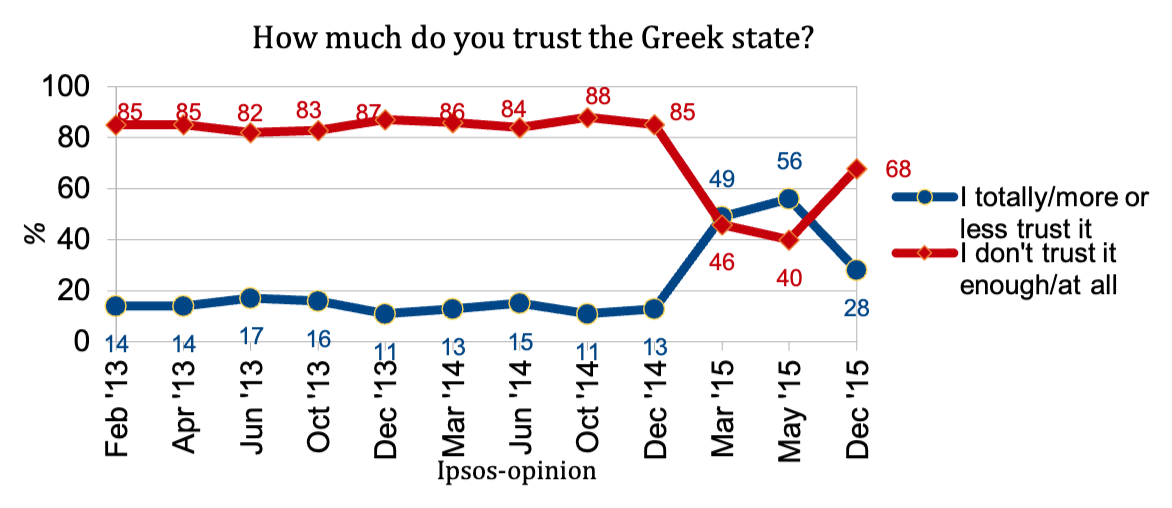
We have a highly polarized divide between a pro and an anti-memorandum/austerity camp, which adds to the left/right divide introducing a more complex reality. The main forces of the Left were part of the anti-memorandum camp (e.g. SYRIZA, Communist Party of Greece & the extra-parliamentary ANTARSYA). On the other hand, the Democratic Left (formed as a split from Synaspismos – leading force of SYRIZA) was part of the pro-memorandum camp. At the same time, right – wing forces, like the Independent Greeks, as well as the neo-nazi Golden Dawn were positioned against the MoU’s.
B. The collapse of the traditional bipartisan system
The collapse of PASOK (Panhellenic Socialist Movement)
In 2009, Giorgos Papandreou became Prime Minister with the motto: “The money exists; it is just that Mr. Karamanlis – the previous right-wing Prime Minister – prefers to give it to the few and powerful.” Soon, PASOK broke its promises and after the first MoU agreement implemented unprecedented austerity policies, which led to the intensification of anger over PASOK’s governance. In a last-ditch attempt to bolster his government, in the autumn of 2011 Papandreou proposed a referendum over an EU-sponsored deal for the partial restructuring of the Greek debt, the so-called PSI. The move backfired instantly. Key members of his cabinet and the EU leadership considered a public vote on the agreement too risky. Papandreou was forced to resign and under heavy EU-pressure PASOK, N.D. and LAOS formed a provisional coalition government headed by Lucas Papademos, the ex-vice president of the ECB. In the elections of May 2012, PASOK lost 2.2 million votes from its 2009 result, shrinking to 13.2 percent of the total, from 43.9 percent in the last election. The collapse continued during the following years with PASOK winning only 4,68% of the vote in the January 2015 national elections. PASOK became a paradigm for the social democratic collapse. James Doran, a UK Labour Party activist back then, has even coined the term “pasokification” to refer to the failures of social-democratic parties in the West the last decade.
New Democracy: The backbone of the pro-memorandum bloc
While the conservative party of New Democracy never collapsed, like PASOK, it also faced a severe loss of its electoral power and its ability to articulate a potentially hegemonic political project. In May 2012, New Democracy lost 1.1 million votes from its result in 2009. It came first and won only 18.9 percent of the overall vote, a record low for the conservative party. Despite defeats and splits (see below, Independent Greeks), New Democracy managed to become the backbone of the pro-memorandum and pro-EU bloc, the leading force of the coalition government formed after June 2012 elections and the heart of the so-called anti-SYRIZA front.
C. The meteoric rise of SYRIZA (Coalition of the Radical Left)
The biggest surprise in the May 2012 elections was SYRIZA (Coalition of the Radical Left), until recently a small party of the Left that came second and increased its showing from 4.6 percent and 315,000 votes in 2009 to 16.8 percent and 1.1 million votes in 2012. SYRIZA was number 1 in the ages between 18 and 35, No1 in unemployed and public sector employees, No1 in all the popular neighborhoods. In June 2012 elections came second once again with 26,89 % of the vote. Following these achievements, the next years SYRIZA was the leading force of the anti-memorandum bloc and was undergoing a process of transformation into a party of government. In the 2014 Euro-elections SYRIZA came first.
What were the main parameters that determined the spectacular rise of SYRIZA? In the early 2010s, both SYRIZA and the Communist Party were the parliamentary representatives of the anti-austerity movement. However, before the May 2012 elections SYRIZA proved more capable of transforming popular discontent into a powerful political and electoral dynamic. The party’s central slogan, ‘We don’t want you to vote as a protest, but so that we can govern’ proved extraordinarily successful. For sizeable parts of the electorate, the county’s traditional political establishment seemed unable to handle the crisis. This was not so much a reflection of changing ideologico-political preferences as it was a re-appraisal of the political elite’s competence to serve the country’s interests. In this context, with its emphasis on a unified anti-austerity campaign, solidarity structures and the open call for an antimemorandum government with SYRIZA in its core, SYRIZA emerged as a viable political alternative (despite its programmatic ambiguities, session 4 on the EU parameter). In the January 2015 legislative elections SYRIZA won with a commanding lead over the right-wing New Democracy.
D. New actors in the right – wing spectrum
Independent Greeks
A split of the right-wing New Democracy, the Independent Greeks were formed two months before the May 2012 elections, run the elections with an explicitly anti-memorandum, anti-austerity agenda and came fourth with 10,61% of the vote. This party exhibited a pro-EU orientation but, unlike SYRIZA, it was socially conservative, free-market oriented and openly nationalistic in key foreign policy issues. Despite SYRIZA’s politically and symbolically loaded victory in January 2015, it lacked an outright parliamentary majority and formed a coalition government with the right-wing anti-memorandum party of the Independent Greeks as the junior partner.
Golden Dawn, ‘one of the darkest pages in the history of Greek democracy’
The most dangerous development in Greece during that period was the rise of Golden Dawn, a neo Nazi criminal organisation that assumed the form of a political party and managed to enter parliament in 2012 winning 18 seats in the 300 seat Parliament (6,92% of the vote). Apart from racist and ultra-nationalist, Golden Dawn was hard Eurosceptic and anti-globalisation and became a key player in the right-wing end of the anti-memorandum camp. In the 2009 parliamentary elections in Greece, Golden Dawn had received only 19,624 votes. Almost three years later, in the June 2012 parliamentary elections 426,025 Greek citizens voted for Golden Dawn. Manolis Glezos, the anti-fascist veteran and SYRIZA MP at the time, described the entrance of Golden Dawn to Parliament as ‘one of the darkest pages in the history of Greek democracy’.
E. Key questions
In comparative terms, there are three main questions that we would like to address:
- Italy and Greece seem to have experience a wholesale disintegration of their traditional party systems whereas in Spain and Portugal the established ‘parties of government’ managed to retain their hold on power. Why is that?
- Reflections on the following observation: In Spain and Greece, in particular, there occurred a strong resurgence of the leti, in contrast to what transpired in Portugal (Bloco and the CDU experienced marginal or fluctuating gains) and Italy (depending if we count M5S as a leti-wing formation or not).
- SYRIZA – Podemos: Main similarities and differences through a parallel reading of their emergence.
Indicative bibliography
Doran J. (2013), Liquidating Labour, Novara Media, available at: https://novaramedia.com/2013/09/15/liquidating-labour/ Karyotis, G. & Gerodimos, R. (2015), “The Politics of extreme austerity: Greece in the Eurozone crisis”, Palgrave-MacMillan, London Karyotis, G. & Rudig, W. (2015), “Protest participation, electoral choices and public attitudes towards austerity in Greece”, in Karyotis, G. & Gerodimos, R., “The Politics of extreme austerity: Greece in the Eurozone crisis”, Palgrave-MacMillan, London Moschonas, G. (2015), “Syriza’s tremendous path to power”, available at: https://transform-network.net/blog/article/syrizas-tremendous-path-to-power-1/ Papadimitriou, D. & Zartaloudis, S. (2015), “European discourses on managing the Greek crisis: Denial, distancing and the politics of blame”, in Karyotis,G. & Gerodimos,R., “The politics of extreme austerity: Greece in the Eurozone crisis”, Palgrave-MacMillan, London Papandreou, G. (2015), “Reflections on the Greek and Eurozone Crisis: A view from the Inside” in Karyotis,G. & Gerodimos,R., “The politics of extreme austerity: Greece in the Eurozone crisis”, Palgrave- MacMillan, London Papanikolopoulos, D., & Rongas, V. (2020). “Movement, party and electoral dynamics. Syriza’s electoral success as a movement effect (2010-2015)”, Ελληνική Επιθεώρηση Πολιτικής Επιστήμης, 45(1), 181–203. https://doi.org/10.12681/hpsa.22316 Teperoglou E. and Tsatsanis E. (2014) “Dealignment, De-legitimation and the Implosion of the Two-Party System in Greece: The Earthquake Election of 6 May 2012”, Journal of Elections, Public Opinion and Parties, 24:2, 222-242, DOI: 10.1080/17457289.2014.892495 Vernardakis, Ch. (2012), “The Greek Left in the 2012 Elections: The Return to the Class Vote”, available at: http://www.vernardakis.gr/uplmed/155_The%20Greek%20Left%20in%20the%202012%20Elections%20% 281%29.pdf
Discussion
Q1. Italy and Greece seem to have experience a wholesale disintegration of their traditional party systems whereas in Spain and Portugal the established ‘parties of government’ managed to retain their hold on power. Why is that?
Lorenzo Zamponi (Italy)
On the disintegration of the party system
In Italy we already had a complete disintegration of the party system before. All the parties that constituted the Italian party system for 40 years ceased to exist for different reasons between 1992 and 1993. If you look at the political landscape now you have, more or less, the same parties that existed in 2008 – with a different configuration, but still the same parties.
Legitimacy crisis – Low turnout & mistrust
Some of the basic effects of the economic crisis are the following: Significant legitimacy crisis evident in electoral turnout and mistrust. Low trust towards political institutions and dissatisfaction with democracy in Italy are similar to Greece. Electoral turnout has been dramatically dropping in Italy. Last year, in the national elections only 63 percent of Italians voted, which is an incredibly low number for a country that 30, 40 years ago used to have 90 percent turnout. Some milestones have been the collapse of Berlusconi’s right-wing party, the technocratic government led by Mario Monti and the lack of credibility of the center-left (Democratic Party) for its support to Monti’s government.
The emergence of the M5S
The emergence of the M5S has been a significant innovation. It began in 2007-8 against political corruption, Berlusconism etc. The first 5 years M5S existed more at the local level and ended up being a significant force. Due to the grand coalition, the technocratic government had no other opposition other than the M5S. In February 2013, the first time M5S ran national elections, it took 25% of the vote. It managed to get votes both from dissatisfied Berlusconi and anti- Berlusconi supporters. Before, the levels of bloc volatility were very low in the sense that there existed a center-left coalition and a right-wing coalition with which people used to identify very strongly. You could switch between different parties within the blocs, but you could not switch from one bloc to the other one. The M5S ended this. Now, they are a potential minor ally to the main centre-left party. Their program is to the left of the Democratic Party on most issues, especially socioeconomic and distributive issues. However, some of their positions are still quite hard to digest for the leftist electorate, like their conservative position on immigration. There seems to be a certain resilience in the party system because the 5SM – that was born as something completely different, neither left nor right-wing, getting votes from both sides – has been gradually transformed into a structural part of the center-left.
Consuming parties and leaders
We are really consuming parties and consuming leaders quite quickly in Italy. It’s a problem of waste disposal at a certain point. The general tendency as a result of the economic crisis goes as follows: Massive political upsurge in terms of political popularity and really exploding voting support followed by a very quick decline. The pattern is that opposition parties tend to enjoy an incredible amount of support and are, then, punished as soon as they are in government. This is related to the structural incapacity under the austerity regime to fulfill electoral promises and to deliver anything.
On Meloni and continuities in the right-wing spectrum
I don’t agree that we had a complete disintegration of the party system in Italy. My standards for a complete disintegration of the party system are quite different. What is going on now with Meloni is revealing a big continuity on the right-wing spectrum. If you look at who’s in the Council of Ministers, half of them were part of the last Berlusconi cabinet between 2008 and 2011. Of course with the radicalization of the right, different relationships of strength within and between the parties etc. But they are still working as a coalition.
Paolo Gerbaudo (Italy)
The aim of the workshop – revising the debate
I take the spirit of this workshop as being a way of revising the debate we had in different places from the mid to late 2010s. Well, we were in a way discussing similar things, but perhaps with very different answers to the one we are going to give in this workshop. At that time we were in the heat of the moment – the heat of the so-called populist moment – there was a sense of great disintegration and a sense of great possibility. I think that the overall sense we’re getting now is, indeed, one of greater resilience of the party system despite the counterintuitive tendencies that we expected.
Populist challenger parties / Comment on the M5S
The basis to examine parallelisms between Greece, Italy and Spain is that in all these countries there was a populist challenger party during the 2010s. Podemos and SYRIZA are clearly left forces. M5S is much more difficult to position ideologically. M5S was born as a force of contestation of the Democratic Party. It was not the usual kind of radical left contestation. It was more of a kind of peronist, populist contestation happening there. Grillo wanted to run in the primary of the Democratic Party. The milieu M5S was born out of, was partly the anti globalization movement, especially in certain towns such as Naples. The transformation of M5S was astonishing both ideologically and policy wise, in a sense that it turned from a party whose identity was direct democracy to a social democratic party under the direct democracy banner, a party that stands for a minimum wage, for a moderate return to public ownership etc. This is an internal modification of the centre-left and perhaps also of social democracy within each and every country.
The return of the centre-left/ centre-right polarity
The general framework that was adopted in 2010 was one of opposition between populists and non-populists, populists versus the establishment, the elite. Around the turn of the decade, in 2020, there has been a clear return of the center-left and center-right polarity, with the new populist forces being themselves reabsorbed within a kind of center-left and center-right dynamic.
The right-wing in Italy is combining some elements of the Berlusconi politics in terms of economic policies in favor of small entrepreneurs and small businesses with more overtly nationalistic elements and with protectionist elements.
Jorge Sola (Spain)
On the relative stability of the party system
We have to nuance this point of view about the stability of the Spanish political system. It’s a relative stability. The two parties have retained power but they must share this power with other forces now, with Podemos and, later, with Sumar on the Left and with Ciudadanos and, later, with Vox on the Right. I think that this change had a generational component as well.
On the Spanish Socialist Party
The Pasokification of the Spanish Socialist Party never happened. First, the impact of the economic crisis was not so huge in Spain compared to Greece. Second, the multi-level political system in Spain, with a very decentralized structure of power, perhaps contributed to greater social rootedness for the two big parties in each city and each region. These roots may have contributed to the resilience of these big parties.
On the Left – Right cleavage
In Spain besides the relative stability of the political system, there is a huge stability in the electoral support to the Right and to the Left. The two blocks have remained almost unchanged. The Left – Right cleavage is still as relevant as in the past.
On the new parties in the Right
Ciudadanos (more liberal) and Vox (radical right)
Their electoral or social base is not as different as their ideology or discourse. In both cases, there are people who voted for the Popular Party before and that were annoyed with the corruption and all the stuff. So it was a vote of protest. Ciudadanos has been, at least partly, a response to Podemos. They played the card that they are beyond Left and Right, with technocratic solutions, etc. At the end of the day, it was a right-wing party and many of their leaders are now supporting Vox.
Dora Fonseca (Portugal)
On the Portuguese Socialist Party
The Pasokification of the Portuguese Socialist Party never happened. Even though the Prime Minister of the Socialist Party at the time, José Sócrates, resigned and left the country with a huge debt, he was not the one that applied the austerity measures. So, the Socialist Party wasn’t regarded as the big monster that applied austerity. The right-wing coalition parties were the hated parties.
In 2015 when the left-wing coalition was formed, the most severe measures were already over.
Catarina Principe (Portugal)
On the political system
I think there are two different periods. The 2011-12 period and, then, the SYRIZA/post-SYRIZA period. During the 2011-12 period, the Prime Minister started implementing austerity measures
- not Troika-like but still austerity measures – since the end of 2010. This is why the first mobilisations in Portugal started during that period, with a big general strike in November 2010 and the first very big demonstration in March 2011. The agreement with the Troika was signed in May and snap elections took place in June 2011. The three main parties had signed the agreement and only the Left Bloc and the Communist Party didn’t sign it. The Left had bad electoral results due to not signing the memorandum, since that choice was seen by many as irresponsible. The idea that “we are living above our capacities” was widespread among the electorate. The Socialist Party dropped from 36 to 28%, a significant drop but still part of the normal rotation of the two-party system. The center-right formed a coalition with the conservatives, the Christian conservatives (major/junior coalition government). Then, four years of political stability followed. Nothing happened in four years. An interesting and important point to consider is the fact that Portugal didn’t have to proceed with a second memorandum. The general vibe was that we’ve made all these sacrifices for these four years and they were worth it.
Low turnout
The very low turnout is also a very important aspect. In the snap elections of 2011, the turnout was 58% and in the 2015 elections, after four years of mobilizations and general strikes, the turnout was 55%. And it kept falling after that.
Questioning the populist framework
Commenting on Gerbaudo’s refere-nce to the populist framework, it might apply to Italy and Spain but I doubt whether it can be applied to Portugal and Greece because of the structure of the party system and the role of the left-wing parties that were in place. SYRIZA has existed as a left-wing coalition, self-identified as such since 2004. And the same goes for Left Bloc in Portugal. SYRIZA and the Left Bloc were very similar in their re-composition since ’99.
Josep Maria Antentas (Spain)
On the relative stability of the party system
Compared to other European countries, the political system in Spain might look stable. But it’s not the stability that the Spanish political system used to have. It did not collapse but it didn’t work like it did prior to the crisis. We had an in-between situation, but it’s true that we had expectations about a collapse that did not happen.
Explaining why PSOE managed to rebuild and Podemos lost ground
The 15M movement began to have political impact in 2014. So, it took almost 3 years to crystallize politically and the most critical moment was, indeed, 2014. The system was near to explode but this finally didn’t happen. Instead, PSOE was able to rebuild in contrast to Podemos and Sumar that lost ground. The following are some possible explanations: The hardest moments of the economic crisis were over by 2015-16. Most importantly, Brussels gave a lot of breath to Mariano Rajoy governments in order to prevent the collapse of the Spanish system. When Tsipras won the elections in Greece in January 2015, Podemos was leading the polls in Spain. So, there was clearly a decision from Brussels not to press the Spanish government to give them room and prevent everything from exploding.
In Spain we had a kind of non-synchronization of the social moment of the crisis and the political one. In 2014 struggles were fashionable and if you had a small demonstration, it would be on television and so on. But the time of big social struggles had already passed. In fact, Podemos was partly created due to this reason. The gas of the 15M movement began to run short. Some activists reached the conclusion that social struggle is not enough and decided to go into politics. Podemos promised a fast track victory which motivated many people. But when the fast victory didn’t come, there was a kind of de-mobilisation.
When Podemos failed to surpass PSOE, it changed its position and proposed a coalition government with PSOE. This way, Podemos helped to make PSOE appear as a Left party again. All these maneuvers of Podemos created panic within PSOE. The current leader, Pedro Sánchez, was deposed by an internal coup by the most right-wing elements within PSOE, but he was later able to take back the control of the party. That gave PSOE a new breath since it became a party of a new generation of members, somehow a party that had taken a little bit of the 15M movement spirit. It was, of course, fake, but that’s how it was perceived and PSOE was able to regain a more hegemonic role.
The Catalan crisis & the role of the national question
It’s impossible to understand what happened in Spain during this period without examining the Catalan crisis. In its maximum moment, during 2017, the Catalan crisis changed the political landscape and created a context that favored more reactionary trends in Spanish politics. Even Podemos was uncomfortable with that situation. The political system in Spain is a product of two elements, the Left and Right divide on the one hand, which is typical everywhere, and the national question, on the other hand. And this makes the political system a little bit complicated.
The Catalan Socialist Party became the most important force in Catalonia because it was able to retain the votes of people who were against independence, but that in the same time didn’t want more conflict and rejected the Spanish right-wing line that wanted to keep conflict and tension in permanence.
Ciudadanos was a strange project, since it was two things at the same time. First, a Spanish hardline nationalist party in Catalonia. Second, after 214 it was promoted as a Spanish-wide right-wing alternative to Podemos. A new kind of liberal party, a way to renew the Right. They have no reactionary positions when it comes to church, abortion, women, and so on but were clearly neoliberal and probusiness. They are not left wing but they are not reactionary either. However, the liberal dimension of the party and the hardline reactionary nationalism don’t match so well. Also they liberal profile became to be combined with right-wing demagogia regarding immigration since 2018 to compete with the new leadership of PP around Pablo Casado that was more ideological than the one of former President Mariano Rajoy. One day Ciudadanos would be like Emmanuel Macron, the other day like Le Pen regarding immigration or even Franco when it comes to Spanish nationalism; a very fragile project, a media project with no social base. In a more historical scope, the defeat of Ciudadanos reflects the weakness of the democratic and liberal right in Spain. The Right in Spain has always been a hardline, reactionary, authoritarian Right without any liberal tradition.
Second round
Angelos Kontogiannis’ questions:
To Josep Maria Antentas: a) The overall structure of the Greek and the Spanish party system was more or less quite similar prior to the crisis. Why did the Spanish Left fail to ride the wave of anti-austerity movements (Indignados etc.) as SYRIZA did? b) Why we don’t have a fissure of the center-right in Spain in an anti-austerity direction, like it happened, for example, in Greece with the Independent Greeks?
To Paolo Gerbaudo: What occurred in Italy during the crisis doesn’t resemble the total dissolution of the traditional parties as it happened in the early nineties. And definitely you have the two blocks, the center-right and the center-left and a rather stable equilibrium of power. But the changes within these blocks seem to me to be more significant than what you described. In the right-wing spectrum do we have only new figures and new parties or new policies as well? The center-left in Italy is still a mystery. What happens in terms of discourse? How do the developments in the center-left relate to the low electoral turnout? Our hypothesis in Greece is that a big part of electoral abstention is primarily driven by disappointed voters of the center-left who are not finding a way out in the political system. Can we say the same about Italy?
Costas Gousis’ questions:
On the impact of SYRIZA on the Left in Portugal and Spain
To Catarina Principe: You mentioned that when the Left Bloc proposed a government of the Left in Portugal, that was an important strategic shift. To what extent this proposal had been influenced by Syriza’s similar proposal in Greece?
To Josep Maria Antentas: You mentioned Podemos’ promise of a fast-track rapid victory. To what extent this promise might have been influenced by the dynamics of the meteoric rise of Syriza and its own promises of a fast track victory?
To everyone: Concerning the participation of the left-wing forces, both in Spain and Portugal in coalition governments with more traditional, center-left social democratic parties, do you consider it as part of the destabilization dynamics of the 2011-12 cycle of protests or a sign of the defeat of this radicalization and a return to a more stable political system?
Paolo Gerbaudo
On the difficulties to establish new organisational structures
I would like to begin with a more general comment. We are now much more aware of the resilience of incumbent political parties, and perhaps there was a certain degree of naivety about thinking that you can displace an incumbent political party. We didn’t take into account the enormous amount of resources, economic, organizational, political and moral that it takes to establish organizational structures that are widespread, well rooted and distributed in the territory. This is fundamental, for example, for winning local elections, which in the long term have been a very important weakness for the M5S, for Podemos, and I guess for other parties as well. The elements of durability and permanence have been overlooked.
On the populist moment
You have two kind of populist moments or two views of it. One is related to new parties emerging at different times, entering the scene clearly presenting themselves as anti-elite and anti-establishment parties. Another dynamic which is the Greek and Portuguese case is pre existing parties of the Left, actually coalition parties. I am not sure about Portugal but my sense is that in the Greek case there is a short-lived populist moment for SYRIZA between the Aganaktismenoi and the July 2015 referendum. Basically, the discourse and the ideology of SYRIZA absorbs some of the populist elements that have become part of the political imaginary of the time as a result of the memorandum and the mobilization in the squares; this almost messianic sense, this sense of dramatic renewal, the hope that writes history. I would like to ask Catarina Principe whether something similar happened to Bloco as well, discursively at least, if there was momentarily that element?
On Meloni and the continuities in the right-wing spectrum
In terms of what happened in Italy, if you see Meloni’s policies, she is incredibly lame and visionless. She is actually very weak because she doesn’t have much autonomy vis a vis the economic interests she represents and she is quickly backtracking on many things. I would say 70% of her policies are Berlusconi’s policies. You can call it third-world neoliberalism, a trajectory for a third world economy – tourism, small enterprises, self-employment and a defense of partly state-owned companies which are the only real capitalist companies in Italy.
On M5S and the extreme neoliberalisation of social democracy in Italy
Italy turns from a country with the biggest communist party in the Western world to the country where the neoliberal shift was the most extreme. It’s a weird situation where the consensus moves so much to the Right. One very interesting observation is that the minimum wage policy, which is considered a kind of common sense policy in any other country in the Western world, in Italy has been opposed by the Democratic party until recently. And the M5S has been the force that put this demand back on the agenda. In that sense, Italy is a very clear case of complete neoliberalization of social democracy, perhaps the most extreme bourgeoisification of social democracy. And precisely because of that, what the M5S is doing is not much more than reinserting social democratic policies in the center-left discourse.
Josep Maria Antentas
On a potential right-wing anti-austerity split that never happened in Spain
There is no real current Spanish Right with a strong social dimension. It’s a highly neoliberal Right. In the split of Independent Greeks from New Democracy in Greece, the framework in which Greece was being somehow humiliated by foreign powers and so on may have played a role in defending national dignity from a right-wing perspective. In the case of Spain, it was never framed like that. So you could not have a kind of patriotic split to defend the dignity of Spain.
On the participation of Podemos in the coalition government
It’s a clear sign of defeat in the sense that it abandoned the hope of victory and it changed the programmatic project of Podemos which became afterwards more linked to the Euro Communist tradition. It’s clearly a shift to the Right and an endorsement of traditional politics. When you are in the government, you begin accepting things that you used to be against. Your ties with social movements and activists become more difficult. And it’s clear that in the case of Spain, the one who rules in the government is PSOE. At the same time, it’s true that being in the government means that Podemos had more relevance, more power and a certain (minor) influence in political life. PSOE would prefer to rule alone, but that was not possible. So, it shows the strategic defeat of Podemos but it also shows that the political landscape changed in the sense that the absolute hegemony of PSOE and social democracy is not anymore as it used to be in the past. PSOE has been forced to accept a junior partner in the government, but at the end of the day, all the key policies that the government has implemented were mainly the ones that PSOE would have done alone – with few exceptions. That’s also very clear.
Explaining why the Left in Spain could not capitalize the situation like Syriza did
The Left in Spain was weaker compared to the Left in Greece in terms of organization, electoral power and cultural legitimacy. At the time of the financial meltdown in 2008, the Left was totally exhausted. That’s why the 15M movement emerged outside of the Left, including the radical one. After 2011 there was more space for the Left, but the Left was weaker and isolated than ever before. In other words, the ideas of the Left could have a lot of credibility against banks, capitalism etc. but the Left had no way to address people. The majority of the Left approached the crisis as business as usual, struggling for two more MPs in the elections or keep doing the same things in the streets, recruit a few members more, etc. So there was a total vacuum, and the majority of the Left did not understand the need to change the rhythm, the need to change and to seize the opportunities that were there. Podemos read the context well, that’s the important thing. You can frame this in political science jargon by saying that there was a window of opportunity. Also, according to Walter Benjamin, catastrophe is to miss the occasion. There was an occasion and the train was passing, and either you jump into the train or you let it go. The majority of the Left did not analyze the crisis like that.
On the impact of SYRIZA’s rise in 2012
In this shift towards politics or in this emergence of Podemos, Syriza’s rise of 2012 was critical. Because 2012 was the most complicated moment of the Spanish crisis. It was one year after the 15M movement, and there was the bailout of the banking system in the summer of 2012. And suddenly, a left-wing party almost won the elections in Greece. Then, many activists endorsed the idea that going to politics was necessary in Spain as well. It was a key element to understand that. When Podemos emerged in 2014, in the European elections, it was not the only new force. There were other projects running for the European elections. You had the X Party, a kind of technocratic, free software kind of thing – maybe similar in a way to the pirate party in certain European countries. And there was also a candidacy led by a judge, a kind of anti-corruption, ambiguous thing. If Podemos did not exist, probably one of these two projects would have been successful, but Podemos was the most skilled and managed to fill that vacuum. At the end of the day, Podemos’ emergence reflects the weakness of the organized Left, although the Podemos’ project began by left-wing activists.
Catarina Principe
On the populist moment
It’s interesting because when we say populism, sometimes we have different things in mind. I think this idea of the ones from below and the ones from above, the cats and the mouse, the 99% against the 1%. This is something that did not make its full way into the organized Greek and Portuguese politics the same way it did at least in Spain. In Portugal, it did not make its way because of the presence of structured left-wing parties with clear left-wing programs that had been in place. I don’t mean that the Left in Portugal did not build from the discontent of the movements, but this shift in the narrative did not exist in the same way.
On the impact of SYRIZA on the Portuguese left
After the 2011 elections in Portugal, when Bloco lost more than half of its votes, a year of strategic debate within the party followed. Because of the mobilizations and what was happening in Greece with Syriza, the Left Bloc called for a government of the Left. Of course, it doesn’t mean the same thing to call for a government of the Left when a party is growing in the polls like Syriza did and when a party has 5% like the Left Bloc. It was an effort to glue the experiences, although the Left Bloc was in a very different relation of power at that precise moment. The second moment is in 2015 when the Left Bloc built on Syriza’s electoral victory creatively. First, the Left Bloc was building its public persona as the sister organization of SYRIZA in Portugal. And, then, the situation in Greece opened a space for the critique of the European institutions. By winning the elections, Syriza provided the possibility of thinking that an anti-austerity party could actually win. Of course, when Syriza signed the memorandum, the euro critique disappeared from the Left Bloc’s public discourse.
The good student of austerity: Comparing Portugal to Greece
If you compare it to Greece, Portugal has a very interesting story because Portugal was always perceived—that was the public discourse on the side of the European Commission — as the good student of austerity; an example of applying austerity with not much social contestation, without any turmoil in the traditional political system. This is the reason why the right wing was able to win the elections after four years of austerity. However, winning was not enough for the right-wing to form a government at the time.
On the participation of the Left in coalition governments
I don’t want to give a simplistic answer, but I think that the participation of the Left in coalition governments was a decision made out of weakness. It was not building on the dynamics of the previous moment. It was more what was left from that moment. Let’s follow the context. In 2015, the Portuguese parliamentary composition allowed for the first time for a coalition government between the center-left party, the Left Bloc and the Communist Party. The Socialist party had a huge internal crisis, in order to even negotiate this agreement with the Left. But they understood that the only way for them to avoid Pasokification was actually to bring the Left into their cohort. So, they formed an alliance with the Left to reestablish themselves. And I think that was exactly what happened in Portugal and Spain. And, in my view, the main reason why the political system did not collapse the same way was because both Sanchez and Costa were very smart in rebuilding their parties with the Left. They made some concessions, not so many, but they tied the Left to the government. At the same time, if we look at the cycle of contention, they tied the Left to the system, the critique to which was the foundation upon which a lot of these movements were built on. It’s also interesting that in Portugal it was exactly at this moment that the far right party was formed which was afterwards the one that holds the banner of the anti systemic critique.
Angelos Kontogiannis
Catarina, you are, in my view, partially right and partially wrong when it comes to Syriza. You are partially right in the sense that, indeed, Syriza took the discourse of the Aganaktismenoi and transformed it quite closely to a traditional left-wing discourse. That is true. And if you follow through the development of the trajectory of this discourse from 2012 up until 2015, when Syriza got into power, you would see that by 2015, they came closer to their usual repertoire so to speak. But the Aganaktismenoi were very crucial because they allowed for two things. First of all, they elaborated a discourse that breached the cleavage between Left and Right. And this was also reflected in the electoral arena because you had transfers of votes in 2011 directly from New Democracy to Syriza and later from Independent Greeks to Syriza (so indirectly again from New Democracy to Syriza). This was something that wouldn’t have happened prior to the Aganaktismenoi. So, part of the electorate moved from a right-wing conservative orientation moving to a left-wing, anti memorandum orientation. And the key thing that allowed this to happen was the all encompassing discourse of the Aganaktismenoi and the unitary identity that they formed even for a little while. It’s important not to miss this “we are citizens” discourse – Paolo has written a book on it – this whole frame of citizenism and the way it re-articulated the whole discourse.
A question to Paolo: You said that around 70% of Meloni’s are similar to Berlusconi’s. Would you go that far as to say that in reality both Lega and Fratelli d’Italia are different managers in a policy that is a re-incarnation of traditional Berusconian politics, or this approach would underestimate the novelty that they bring in?
Paolo Gerbaudo
Responding to Angelos:
Berlusconi – Meloni: Same policies, different ethos
According to an argument I made recently that there is a big break, a kind of post-neoliberal one, I need to restate a bit what I said. I said that 70% of Meloni’s policies are basically the same with Berlusconi’s, but the ethos is 80% different so to speak, in a sense that the very same policies are now presented in a very different light. So, for example, in the time of Berlusconi, we had the defense of Italy as a huge self-employed sector, as a huge small business sector, all this stultifying rhetoric of small and medium business. And I think this shopkeeper mentality is something we share as Southern Europeans. And it is also similar in the other side of the Mediterranean, like in Tunisia. The shopkeeper mentality is not, as Marx was saying back in the time, a British characteristic. It is a characteristic of Mediterranean culture and is actually very problematic in terms of economic inefficiencies that then reflect on low salaries, low productivity and so on and so forth. At the time of Berlusconi, this was presented as an aspirational kind of policy, wanting to become an entrepreneur, while now it is presented almost as a kind of measure of despair. There’s these people who got into this aspiration track under neoliberalism, who are now stuck in this shit life prospect and then the state is basically saving them from the market. It’s not anymore a promise of serving the market and becoming a big entrepreneur. This is now the kind of politics of salvaging Italian capital against the market. Because you realize that in any real market condition, these enterprises, these self-employed people would be completely destroyed by the market laws. Then, culturally it is different because Berlusconi was all about sex jokes. But besides the kind of epiphenomenal element, it was about the politics of desire, it spoke to prohibited sexual practices. Meloni is a kind of traditionalist which is completely hypocritical but there is a very big change in the ethos there as well.
ΣΥΝΕΔΡΙΑ 3
The Post-crisis Landscape
Objectives
Description
The primary objective of this session is the examination of the characteristics of political competition in the post-crisis landscape.
Key subjects
- Are we witnessing a phase of actual political stabilization and declining radicalism or political discontent remains latent?
- What underlies the decline of the (radical) Left in the post-crisis period?
- What are the key parameters underling the thrust of radical right formations into the political mainstream?
Background paper
A. The post-crisis landscape in Greece
Officially the Greek fiscal and sovereign debt crisis ended on August 2018 with the conclusion of the third bail-out program. However, the brief analysis that follows covers the entire post-2016 period, as many of the dynamics at play are rooted in SYRIZA’s political re-orientation in the aftermath of the 2015 referendum.
The transformation of the party system
If we are to fully understand the trajectory of the crisis and the transformations that it brough about in the structure of the party system we need to take a mid-to-long term perspective. This enables us to identify points of rupture, elements of continuity, and most importantly the long-term impact of certain events and dynamics. That being said, in the period spanning from 2009 to the present day we can distinguish three major changes in terms of political competition and the power balance between the Left :
- 2012-2019: The so-called “earthquake elections” of 2012 marked the collapse of the traditional by-partisan system and the emergence of a fragmented multi-party system with two dominant poles; SYRIZA on the anti-memorandum camp and N.D. on the pro-memorandum camp.
Causes: There were three major dynamics underlying this transformation: a) SYRIZA’s replacement of PASOK as the dominant political power in the center-left, b) the fragmentation of the center-right (ANEL, To Potami) at the expense of New Democracy, and c) the emergence of a radicalized far-right as a major political actor (Golden Dawn).
- 2019-2023: After the legislative elections of 2019 the party system seemed to revert back to its pre-crisis structure. ND and SYRIZA had a combined vote share of 71.38%, the KKE stood close to its average in the late 90s-early 2000s, while the Hellenic Solution and Mera25 resembled both in strength and policy positioning LAOS and the pre-crisis SYRIZA.
Causes: This was the result of two primary dynamics: a) the decline of political radicalism due to the effective dissolution of the anti-memorandum camp after SYRIZA’s political U-turn and b) the temporary suppression of far-right radicalism due to the dissolution of Golden Dawn.
- 2023-onwards: The legislative elections of 2023 seem to mark a turning point in Greek politics as they led to the emergence of a fragmented multiparty system with only one dominant pole, New Democracy. SYRIZA’s electoral collapse while in opposition (31,5% in 2019 – 17,83% in June 2023) and PASOK’s inability to capitalize on it means that for the first time since the late 70s there is no major center-left pillar in the party system. Moreover, the existence of three radical-right-to-far-right parties (Hellenic Solution, Victory, The Spartans) with a combined vote share of 12,8% points to a resurgence of right-wing radicalism and a significant right-wing turn amid the electorate.
Causes: There are three major dynamics that seem to underlie these results: a) New Democracy managed to create the illusion or the prospect of a “return to normality” after years of economic and socio-political turbulence, b) SYRIZA’s social-liberal transformation left the party in a strategic limbo, severed its ties with petty-bourgeoisie and working class strata and generated widespread disillusionment in the electoral base of the Left, and finally c) after a small hiatus due to the criminal investigation of Golden Dawn the radical right re-grouped and emerged as the main recipient of popular discontent.
Remarks on the current conjuncture
In light of the above, we argue that in-effect the general elections of 2023 mark the closure of the political cycle opened by the crisis in 2010-2011. After an initial tilt to the left and under the impact of the 2015 referendum the political system seems to be moving decisively right-wards in a way that is reminiscent of political developments in Italy after the mid-90s. This doesn’t mean that the party system is stable or at least as stable as it was prior to the crisis but it does point to a rather durable reconfiguration of the power balance between the Left and the Right. To be sure, electoral abstention stands at an all-time high indicating the existence of a severe crisis of representation particularly amid left-leaning and new voters. However, this in itself doesn’t anticipate neither a political crisis nor a re-alignment of the main ideologico-political trends given the current state of political disorientation of the Left.
B. SYRIZA’s transformation and its repercussions
SYRIZA’s transformation from a reform oriented radical-left party to a social-liberal party of the state in the Poulantzian sense -something that relates both to its policy and its mode of governance, i.e. the way it conducted politics- led to widespread disillusionment and the acceptance of the adjustment reforms as a fait accompli. In due course, this led to a decline in union activism, the disintegration of the grassroots initiatives that had proliferated the preceding period, and the emergence of an identity crisis that impacted the organizations of the political left all across the board; the only exception here being the KKE due to its sectarianism. In this context, the party sleep walked right-wards by adopting a moderate catch-all discourse that aimed to sustain its position as the dominant political force on the left of New Democracy. This went hand-in-hand with the debilitation of its internal function, the side-lining of its Central Committee and the enhancement of Tsipra’s role as the ultimate decision-maker on all issues of substance. In effect, by 2023 SYRIZA resembled a party of the elite type structured around the activities of its parliamentary group and the personal appeal of its leader. Its strategy was confined to the prospect of an imminent return to power and the propagation of a more efficient and socially conscious economic management. This over-emphasis on office-seeking coupled with the lack of a distinctive political agenda paved the way for the emergence of the Kasselakis phenomenon, i.e. the endorsement of a post-political approach that places emphasis on mediatic performance, managerial credentials and the side-lining of supposedly outdated political cleavages.
C. The authoritarian specter
Equally important were the transformations that occurred in the right-wing end of the political system. The inclusion of LAOS in Papademos’ national unity government turned the radical right into a legitimate political actor in close proximity to the political mainstream. Moreover, it provided the hotbed for the absorption of radical right figures by New Democracy. This went hand in hand with the authoritarian transformation of the state apparatus and the heavy reliance of the pro-memorandum camp -N.D. in particular- on law order, anti-immigration and anti-union/anti-left discourse. The aim of this was to corner the Left and shift people’s attention away from the reforms. The strategy was partially successful but it came at a significant cost. Running on an anti-austerity/anti-establishment platform Golden Dawn was able to outflank New Democracy and galvanize support amid the more conservative segments of the population. By 2014 the party had a vote share of 9,49% outperforming both PASOK and the KKE. This consolidated the existence of an organized and ideologically radicalized electoral base of the extreme right over which New Democracy’s nationalist overtures held little sway. In this context, the indictment of its leadership led to the disintegration of the party but not of the current that it had help establish. Social networks, underground cells, a complex nexus of ‘alternative’ media and connections with the church and the repressive apparatuses remained rather intact and sustained the radical right as an independent actor. This explains the lightning rise and electoral success of parties like Victory (sponsored by elements within the Greek Orthodox Church) and the Spartans, a spin-off of Golden Dawn under the leadership of Ilias Kasidiaris.
D. Key questions
In comparative terms, there are four main questions that we would like to address:
- The political systems in Greece and Italy seem to have tilted decisively right-wards, whereas in Spain and Portugal traditional social-democratic parties have been able to retain their positioning. What is the cause of this?
- Which are the key parameters that underlie the organizational and electoral decline of the radical-left in the post-crisis period?
- Is there a common denominator in the electoral expansion of the radical right (Lega, FdI, Vox, Chega, Golden Dawn and its successors)?
- Can we talk of political stabilization given the relative fluidity that characterizes the Italian and -to a lesser extent- the Spanish party system or the high-abstention rates recorded in Greece and Portugal?
Discussion
Q1&2: The political systems in Greece and Italy seem to have tilted decisively right-wards, whereas in Spain and Portugal traditional social-democratic parties have been able to retain their positioning. However, in all four countries the radical left has experienced a significant organizational and electoral decline in the post-crisis period. What is the cause of these in your opinion? Elements of continuity
Lorenzo Zamponi: I do not contest the argument that the Italian political system has tilted right-wards but I would like to emphasize the fact that there is also a strong element of continuity between Meloni’s discourse and Berlusconism on issues like taxes, immigration and so on. In other words, Meloni’s election is less of a turning point and more the outcome of a long-term process of transformation of the Italian political system. However, this doesn’t mean that we should treat this lightly. The strong performance of the FdI testifies to a progressive normalization of the extreme right in the political mainstream. The decline of M5S and the consolidation of the right-wing turn This is definitely linked to the crisis. However, one needs to remember that the crisis in Italy stretches back to the 1990s. In that sense, it is a prolonged process that predates the eurozone crisis. The latter did instigate of course a wave of radicalization that boosted anti-establishment parties but this needs to be understood as a process of acceleration of pre-existing tendencies. The Italian Left for example was ideologically and politically exhausted by 2010 and thus unable to capitalize on social discontent. Despite the fatigue and disillusionment over Berlusconi the PD made no gains. It was the M5S that rode the wave of popular frustration by attacking both PD and Forza Italia, while presenting itself as the only true challenge to the establishment in a typically populist manner. As we discussed in previous sessions, more radical appeals were present but they were marginal and primarily confined to the student and trade union struggles. In effect, the forces that emerged out to Berlusconi’s decline were the M5S and the minor forces of the radical right. Under Conte the former had the potential of stabilizing as a leading force in the center-left and the party-system more broadly; a development that could have changed the balance of power between and hinder the gradual right-ward slide of the Italian political system. However, Renzi’s decision to withdraw its support from the M5S-led-coalition government in 2021 eventually led to Conte’s resignation and the formation of the Draghi grand-coalition government. This proved to be determining for two reasons. The first is that the M5S joined Draghi’s government and thus liquidated the political capital accumulated by Conte’s relatively successful management of the economy under Covid. The second is that the alignment of M5S with PD, Forza Italia and Lega under an establishment figure like Draghi paved the ground for the FdI to capitalize on growing popular frustrations and emerge as the leading political power. In other words, it cancelled out the potential of M5S and thus accelerated the gradual right-ward shift of the political system. It is also crucial to note that the Right is much more cohesive as a socio-political bloc, i.e., voters switch easily from one party to another but do not cross to the other camp. This has to do with the weakness of the Left but also to the alignment of Berlusconi, Salvini and Meloni on certain key issues, i.e., to the fact that the right-wing discourse exhibits strong elements of continuity across party lines.
Remarks on stabilization
It is also crucial to note that the Italian right has been able to capitalize on people’s need for stability, something that in other cases, e.g. Spain, is playing out in favour of the center-left. So overall I would say that the right-wing camp is definitely the leading one and this also means that there is a significant degree of continuity in terms of policy despite the occasional changes in the power balance between the various right-wing formations. Now, does that mean that the political system is undergoing a process of stabilization? This is hard to say. There is stability in terms of policy and strategic orientation but given the structural constraints stemming by the EU’s fiscal rules it is extremely difficult for the governments to deliver anything substantial. This is clearly reflected in the decline of electoral participation especially among the popular social strata that bear much of the burn by the decades long process of deregulation and neoliberalization of the economy.
The question of organicity and the problems with hyper-leaderism on the Left
Paolo Gerbaudo: I’m in agreement with Lorenzo over his evaluation of the Left, meaning those forces on the left of traditional social democracy. I think it is fair to say that it is not only in a strategic limbo but also in a state of complete dis-organization. What I think is most interesting in this regard is the political exhaustion of the coalition-party-model and its replacement by a kind of hyper-leaderism. This is evident in the case of SYRIZA with Tsipras and Podemos with Inglesias but you can also see it in France with Melanson. The legitimizing basis for this shift is usually an appeal to the heavy negotiative labour involved in the internal function of parties with many organized factions and their inability to act decisively or in unison. The downside is that in the mid-to-long term this runs the risk of crippling internal pluralism, diverse representation and robust organicity. That is to say all the key qualities that allow a party to endure in time as a collective actor with organic links to its social basis. France Insoumise or Podemos may have been for a time very efficient electoral machines but they lacked depth and the capacity to outlive the charisma of their leaders.
In the case of Podemos this lack of a solid organizational base and emphasis on the unmediated representation of a diverse electorate by a small group of people around Inglesias goes a long way in explaining not only the decline of the party but also the enduring strength of the Socialist Party of Spain. Many times we overlook this but despite its bureaucratization and neoliberal shift PSOE has managed to retain a strong connection with the popular classes and particularly the traditional working class; a constituency in which Podemos did not manage to make headway. To varying degrees this is something that you can also notice in Greece and Italy. In France and Germany things are even more complicated because it is the far-right that has made headway in the working-classes constituencies that once formed the electoral heartland of social-democracy.
The radical right
This brings me to the discussion over the radical right. I concur with Lorenzo that there is an element of continuity between Meloni and Berlusconism but overall I would say that we tend to have an overtly simplified perception of the radical right, its various currents, the ideological underpinnings of its discourse and so on. The structural conditions that make political stabilization superficial I believe the key thing is the incapacity of the Right to establish a new system and hence its inability to escape the current drags of neoliberalism. This goes a long way to explain why they’re investing so much now in geopolitics, i.e., in all these wars, because they are really bereft of any other internal ideological horizon that can give any meaning to what they’re doing. So all in all, I think what we experience now it’s a kind of an illusory stabilization. While there may be a lot of desire for that what seems to be lacking is a basic project for going forward. In this regard, not even the elites that the Right is supposed to represent seem to be in agreement on one.
The organizational limits of SYRIZA and Podemos
Catarina Principe: I would like to jump in after Paolo because I also wanted to say some things about the difficulties of these new left parties that I think are pertinent for the discussion we are having. I think what Paolo points out with regards to the organizational problems of these formations is true, particularly so for Greece and Spain. I the case of Greece, Synaspismos was so dominant inside SYRIZA that the latter was in effect incapable of functioning as a political front with a balanced ‘division of labour’ between its various factions and this hindered its ability to develop its own organicity. The same is true of Podemos albeit for different reasons. Podemos’ leading cadres were not organized and they did not really attempt to create a cohesive organizational structure opting for a top down mode of political representation that would allow them greater autonomy. The downside of this was that the party was organizationally weak and also that the small parties that joined in had decreased ability to affect policy. In contrast to that, Bloco or Die Linke had manage to develop their own organicity, i.e., their own organizational structures and a more balanced internal function that superseded that of their constituent parties. In this regard, the power struggles over the leadership of the latter, despite their shortcomings, testify to the existence of internal pluralism and actual political competition. So, in a nutshell, I would say that neither SYRIZA nor Podemos developed a culture of ‘shared hegemony’ in their internal function, as Bloco did. In other words, they lacked a balanced division of labour and organic links between their various factions and constituent elements. This hindered their potential.
The political limits of SYRIZA and Podemos
Now, beyond the problem of organicity, all these parties had a problematic strategy with regards to their social and electoral appeal. On the one hand they tried to capture the vote of disaffected social-democratic voters as traditional social democratic parties tilted rightwards. On the other hand, they tried to galvanize support amid a younger generation of social movement actors, activists etc by picking up subjects salient to them. In my opinion, this strategy failed because to appeal to the traditional base of the social-democratic parties one needed to be quite integrated to the system, while to appeal to a younger generation, to activists, radicalized social strata etc it needed the exact opposite. This is a rather unsolvable conundrum. If SYRIZA and Podemos managed to overcome it, at least temporarily, this was due to the specific character of the Indignados and the Aganaktismenoi movements and their ability to bridge this gap in the short run.
The case of Bloco
In this regard, I believe that the Portuguese experience in enlightening. At the moment Bloco joined the government with the Socialist Party its vote share dropped dramatically and so did electoral participation in general. From 2009 to 2015 the latter went from 55,6% to 48% that is the sharpest decline of turnout in recent Portuguese history. Why is that? Because the anti-establishment dynamics that emerged out the anti-austerity protests could not be effectively channeled in the party system or taken up by the Left; the latter now perceived to be aligned with status quo powers like the Socialists. What is more, in the elections of 2022 the Socialist Party won an absolute majority, meaning that the Left lost support on both ends; radicalized voters to abstention and temporarily disaffected social-democratic voters to traditional social-democracy. So the party system in Portugal effectively underwent a process of stabilization at the expense of the Left. This is similar, in my opinion, to what is happening in Spain.
Remarks on the fragmentation of the Portuguese Right
Another thing I would like to comment -and relates to what Angelos said earlier- is the fragmentation on the Right. In the elections of 2019, Chega, a far-right populist party made it to the Parliament for the first time. Most importantly, though, in the timespan of just three years it managed to go from 1.3% to 7.2% becoming the third largest party in parliament, while current projections depict the party on 17%. Something that points both to the inability of the Left to express social discontent but also the inability of the traditional center right party, the PDS, to recover after overseeing the implementation of the memorandum. In that sense, there may be a trend developing similar to the ones occurring in Spain, Greece and Italy where radical right parties are normalized in the party system and potentially emerge as the major recipients of social discontent with the status quo. So overall, I would say that there is still some tension in the political system, there is still a crisis of representation but to the extent that the system has stabilized -and it has stabilized to a significant extent- this has happened at the expense of the Left that paid a heavy price for lending its support to the Socialists.
The EU parameter and its relation to abstention
Now with regards to electoral participation, a crucial indicator for the stability of a party system, I would say the following. In Portugal it was very high until the 1980s, i.e., up until the country’s entrance to the ECC/EU, but thereafter it went into a prolonged albeit gradual decline that continues unabated to the present day. To give you an idea, electoral abstention stood at 8,5% in 1975, while in the general elections of 2022 it stood at 48,6%. In this regard, I believe the EU parameter and the policy constrains that the member-states are facing are decisive with regards to the ability of the respective party systems to effectively perform their representation function and thus keep the populace at large engaged in politics.
On the issue of organicity
Dora Fonseca: I want to jump in briefly to add some things. I totally agree with Caterina’s overall reading of the situation in Portugal. I will just add some points starting from the issue of organicity. What Catarina said apropos of the latter with regards to SYRIZA and Podemos, the trade unions were saying with regards to the anti-austerity protests, i.e., that it lacked effective organization. The organizational question is crucial both with regards to social movements and parties.
Remarks on the coalition government and Chega
Now, as for the electoral decline of Bloco, Catarina is right, and I would say the same about the Communist Party. They were both punished for aligning with the Socialists. They didn’t join the government formally but by lending support to it in the parliament they were perceived as part of the establishment and thus ceased to be protest parties. This also relates, albeit indirectly, to the rise of Chega. Of course the latter is primarily a byproduct of the crisis in the Right and the inability of the PDS to fully recover, but to a certain extent it is also a reflection of the inability of the Left to channel and express social discontent. So in effect, Chega capitalized on three dynamics: a) the crisis of the traditional center-right, b) the alignment of the Left with the Socialists and c) the progressive salience of the anti-immigration and anti-establishment discourse.
Remarks on SYRIZA and the dynamic of radicalization in Greece
Angelos Kontogiannis: Thank you Dora. Before turning to Josep and Jorge, I would like to clarify something about the dynamics in Greece because I think it is pertinent to our discussion. There is a big debate here about the extent of radicalization that occurred in the electoral base of PASOK during the crisis. One the one hand, there are those who believe that a great deal of radicalization did actually happen and this was reflected both in the dynamic of the referendum and the dramatic increase of abstention rates in the aftermath of SYRIZA’s capitulation to the creditors. On the other hand, there are those who believe that radicalization may have occurred but it was temporary and superficial. Hence, SYRIZA was able to remain in power despite its political U-turn, because in effect it delivered what its electorate wanted, i.e., a renegotiation without a clash. Both lines of argumentation have pros and cons, although the latter seems to be more problematic in the sense that it treats radicalization as a semi-independent variable; SYRIZA’s strategy and policy choices shaped and not merely reflected the dynamics of radicalization. That being said, I would like to ask you if there is a similar debate in Spain about the attitudes and the political trajectory of center-left voters.
Costas Gousis: I would just like to add the following to what Angelos said. In the post-2015 period SYRIZA advocated for stabilization and the return of normality but by so doing it paved the ground for the resurgence of N.D. because in the eyes of many people it was in itself a symptom of the crisis. This may seem paradoxical given the party’s evident moderation and turn to social-liberalism but in my opinion is reflective of the underlying dynamics and the tension between radicalization and normalization. Given the absence of an actual alternative to austerity, people saw in N.D., an establishment party, the potential for stability or perhaps the semblance of it. This goes a long way in explaining both its current dominance and SYRIZA’s decline in the post-2019 period.
Jorge Sola: I see the logic behind the two approaches laid out by Angelos but I’m a little bit puzzled with regards to the first. In the aftermath of the referendum SYRIZA experienced a left-wing split with the formation of Popular Unity, i.e., a party that rejected the third bailout agreement. If there was a degree of radicalization amid SYRIZA’s electorate why did the latter fail to gain traction?
Angelos Kontogiannis: That’s a nice question. There are two arguments to be made in this regard. The first is that SYRIZA contested the September 2015 elections on a platform that emphasized the existence of a “parallel program” that was supposed to balance out the social impact of the third bail-out. It took some time for people to realize that this was an empty promise given the tight grip of Troika on decision-making processes at all levels. The second is that people, however radicalized, understood the actual power balance and the ability of the EU to crash the Greek economy by pulling the plug on the banks. In other words, the referendum made evident both the cost of rupture and the necessity of thorough preparation if the country was to achieve a negotiated settlement for exiting the eurozone. This never happened and so in the eyes of most people Popular Unity’s advocacy of Grexit lacked credibility because they thought -probably rightly so- that a splinter group was unable to succeed where SYRIZA as a whole failed. But this is an indication of realism not necessarily lack of radicalism.
Jorge Sola: I see. However, the last point you made begs the question if SYRIZA’s leadership took the decisions that it did based exactly on the same rationale, i.e., the tremendous cost of a rupture and the inability of the country to effectively get through such a process. I ask this because I remember an article by Luciana Castellina, back in the day, who argued that SYRIZA signed the 3d MoU not out of choice but because such was the balance of power.
Angelos Kontogiannis: This is a fair point but keep in mind that SYRIZA’s leadership chose to prioritize governmentability over policy, i.e., opted to remain in office and implement a harsh austerity package rather than sticking to its platform. This was a determining choice that set the party to a social-liberal trajectory and effectively to a long-term crisis of political orientation. Because keep in mind that SYRIZA did not just implement the MoU, it consciously opted to outperform its provisions over primary surpluses etc. In other words, it opted to implement a more tight fiscal policy than the one dictated by the program. Why they did that its indeed an important question to which I have no answer. Let’s go back to Spain though because I think we already discussed Greece extensively.
Remarks on Podemos-Sumar
Jorge Sola: In general I agree with most of Paolo’s remarks and in particular with his points about organicity. This is particularly evident in the case of Spain and the dynamic of political formations like Podemos or most recently Sumar that clearly exhibit this tension between organizing or opting for a rather unmediated and personalized appeal of the core leadership; e.g. Pablo Iglesias in the case of Podemos, Yolanda Diaz in the case of Sumar. I’m also intrigued by what Catarina said earlier about the existence of an underlying tension in the strategy of most new radical left parties, e.g., Podemos, SYRIZA, Bloco, Die Linke etc.; i.e., the conflict that emerges out of their attempt to capture both the traditional electoral base of social democracy and appeal to new social movement actors, a younger generation of activists and so on. I say I’m intrigued because I think that overall this is a valid point but I’m not really sure if it fits well with the experience of Podemos. In my opinion, the decline of the latter is related to the fact that it was unable to make headway amid the working-class electorate of PSOE. In effect, Podemos primarily galvanized support amid disaffected petty-bourgeoisie and middle-class professionals that were more amenable to changing political currents. In the heydays of the crisis they tilted left-wards but once the situation stabilized and attention switched to Catalonia and other issues these groups re-aligned with PSOE, their traditional party of choice.
Angelos Kontogiannis: Thank you Jorge. Josep?
Further remarks on Podemos’ strategy
Josep Maria Antentas: Its not easy to give definitive answers to these questions, so I will just make a couple of remarks that I think are pertinent to our discussion. I will begin with my take on Podemos. Its main strength was that it had a capacity to present something very difficult -a change in the balance of power, the overthrow of the established political class, an end to corruption and so on- as quite easy and doable. It soon became apparent that a change of course be it on the economy or anything else was neither easy nor costless and this hindered Podemos’ dynamic, because its strategy was pretty much based on the promise of a smooth transition to an alternative crisis management. In this regard, it is very telling that between the elections of December 2015 and June 2016 Podemos lost 3,3% and then in the elections of 2019 it lost another 6,9% or about 1.400.000 votes. This did not happen because the party moved to the left or the right it happened for two reasons: a) it wasn’t perceived anymore as an anti-establishment force (as it was already in the Parliament and, I think, because its shift towards wanting yo rule with PSOE made it appear as a more normal political party) b) few people believed that change could be easily done. The latter is perhaps best reflected in the repatriation of voters back to PSOE, while the former to Podemos’ gradual decline after joining the coalition government. It is hard to present yourself as an alternative to the status quo when you are in government with an established party of old. So it’s not that much that it lost votes due to its radicalism but rather due to its normalization in the political system. This also relates to the composition of part of its electoral base, which is quite depoliticized; probably one of the reasons why it was captivated by Podemos’ promise of a quick and smooth political change in the first place.
The external parameters that led to its decline
However, its decline it’s not only due to internal dynamics and the evident shortcomings in its strategy. There were significant external dynamics at play. The most important of those, in my opinion, is the progressive decline of social mobilization. As we discussed in the first session, Podemos emerged in the aftermath of the cycle of contention and not its course. This made a lot of difference. In the post-2014 period social mobilization was significantly lower. After 2017 a new social push reemerged with the rise of feminism, first, and environmental struggles, secondly. But these new cycle was more transversal in character, and those struggles were more difficult to turn into a direct and systemic critique of the established political class. And then you had the vicious treatment of the party by the mainstream media and the concerted attacks by PP, Ciudadanos and so on. Something that did a lot of damage particularly as the Catalan independence issue gained prominence. A third parameter that I think played a role was the progressive exhaustion of left-wing and social movement activists. This is a general phenomenon that impacted all strands of the movement but it had a strong impact on Podemos due to its lack of historical depth, established ties with communities, trade unions etc.
Podemos’ organizational model and difference with SYRIZA, Bloco, Die Linke etc
Based on this last remark, I would also like to emphasize that Podemos was a very peculiar party that in my opinion differs significantly from SYRIZA, Bloco, Die Linke and the rest. Podemos had no relation to the traditional Spanish left, it came complete from the outside (although it was created by left-wing activists), and the model that it put forward was one of an “electoral war machine”, i.e., its entire energy was oriented towards winning the elections and media politics. To do that it opted for a highly centralized organizational model, with all decisions taken at the top. At the end of course this proved to be its Achilles Hill. High centralization meant that the regional branches had no power and weak leadership; all decision were taken in Madrid. It also meant that there was no substantive internal debate and no organic links with local movements, initiatives and so on. This soon led to an internal crisis with regional party leaders resigning one after the other either due to pressure from the grassroots or interventions by central leadership in Madrid, particularly in cases where Iglesias and the small circle at the top did not get their way in intraparty elections. All in all, this was a party whose internal function was plebiscitarian, i.e., aiming to maintain a direct link between the core leadership and the voters with no much interference from an organized party structure, intermediate bodies, regional and sectoral branches. Hence you had the novelty of online voting, a procedure that side-lined the party’s activists -those that went to the meetings, sustained its local organizations etc.- in favour of voters or loose party affiliates that were less drawn to, if not utterly disengaged with the intraparty debate.
Podemos’ weak relation to its social basis
In combination, all these dynamics led to the absence of strong grassroots organizations either at the local or the sectoral level. Something that in turn led to the absence of organic links with the party’s electoral base and thus to weak party identities. The sharp electoral decline of the party after the elections of 2016 is a clear manifestation of this. Could things be different? The answer is not simple. In my opinion, any party that is formed in such a way by people that were outside the organized Left would almost certainly face many of these problems. What is striking in the case of Podemos is that the leadership did not try to mitigate any of these even when it became evident that the initial model was leading the whole endeavour to a dead end. Not only that but effectively they took decisions that made things worse.
What was the dynamic of radicalization in Spain?
Angelos Kontogiannis: May I ask both you Josep and Jorge what is your take on political radicalization in Spain in the aftermath of the cycle of contention? Was it a passing phenomenon or it was more profound processes with a lasting impact on the dynamics that underlay the political system in general and the trajectory of Podemos in particular?
Jorge Sola: I couldn’t really tell.
Josep Maria Antentas: Me neither. I also doubt that this is an issue that can be put in such a dichotomic way. Probably the most accurate description is somewhere in the mild. You had radicalization that was in effect conditioned by the dynamic of the events, the choices of the political actors and so on. So it’s quite complex. That being said, I wouldn’t say that Podemos went in decline because it proved to be more moderate or too radical in comparison to its average voter. As I explained previously there were multiple factors at play.
Jorge Sola: I think that the framework of radicalization-deradicalization is unable to capture the process. As Josep mentioned is too dichotomic. The dynamics at play here are quite complex. The most important thing, in my opinion, is what people believed to be the horizon of expectations at any given moment, i.e., what they took to be possible. This determined their choices at a significant extent.
Angelos Kontogiannis: Very fair points, thank you! Lorenzo you wanted to intervene?
The state of the Italian Left
Lorenzo Zamponi: Yes, because earlier I forgot to elaborate on the state of the Italian Left and so on. Just a couple of points on this regard. In Italy there are currently some radical left wing formations but they are quite marginal. However, this is not just an Italian phenomenon but a broader process rooted in the dynamics of the post-1989 conjuncture, the collapse of the Eastern Bloc etc. Portugal and Greece are rather peculiar cases in this regard due to the existence of relatively strong orthodox communist parties but the overall picture is that of a gradual decline of the radical left. If we look at Spain and Greece in 2008, Izquierda Unida had around 3% and SYRIZA around 5%. The crisis unsettled things and allowed the emergence of significant mobilization cycles that re-energized the radical left without upending the structural conditions of its decline. This was most evident in Spain and Greece and less so in Portugal and Italy. Now why is that? In Italy the Left was way more exhausted and thus unable to ride the wave of popular discontent. So the crisis of representation was politically capitalized by the Five Star Movement; a formation that had no links with the traditional left and to a certain degree did not even perceive itself to be left-wing but rather post-ideological, in the sense of not belonging neither to the Left nor the Right. In this context, the gradual decline of the political left in Italy -which should be linearly equated with the social left-continued unabated.
The impact of the electoral law
Another important parameter is the impact of the bipolar system that forced the radical left to either go on its own and self-marginalize or align itself with the a neoliberalized center-left in opposition to right-wing dominance. This conundrum was particularly evident in Italy throughout the 1990s and 2000s partly due to the power balance between the two camps and partly due to the electoral system that favours the formation of coalition governments. In either case from the perspective of the radical left this was a lose lose situation. If it opted out of a coalition with the center-left it was charged for laying the ground to Berlusconism, if it aligned with PD it was perceived as part of the establishment. The recent experience with the coalition governments in Spain and Portugal I think bears significant resemblances to that and pose similar dilemmas. The formation of Sumar for example seems to me to reflect a process of adaptation to the realities of the current conjuncture, that is to say to the different political opportunities that are now present in Spain. Unlike Podemos, a party that strived to be the anti-establishment alternative, Sumar is a political force that is explicitly aiming to be the left-wing component of a broader anti-right-wing coalition. Will that shift in strategy pay off? Is hard to say..
SYRIZA and the PCI experience
One last remark on Angelos’ question over the potential similarities between SYRIZA and PCI and the way their leaderships were co-opted by the political establishment. I think this is definitely true but with a crucial difference. In the case of the PCI co-optation took place in a very protracted process spanning more than two decades, while in SYRIZA’s case it happened in the timespan of a few months. The key similarity here I believe is the idea that a party of the Left needs to be a governmental force. From the 1970s onwards the PCI was fixated with the question ‘how do we become a party of government’, which was usually interpreted as ‘how do we become a force of change rather than mere representation of social interests’. This is of course a valid consideration but in both cases, albeit for different reasons, it ended up to a process of co-optation and absorption by the power bloc.
Q3. Is there a common denominator in the electoral expansion of the radical right (Lega, FdI, Vox, Chega, Golden Dawn and its successors)? Does the EU crisis-management and the concomitant contraction of the decision-making capacity of national governments on key issues like the economy feed into this? Remarks on VOX
Josep Maria Antentas: In Spain the emergence of Vox is clearly related to domestic dynamics and more specifically the reaction to the Catalan independence movement. European integration and the EU crisis-management I think played a minor role, if any, to its emergence although perhaps they lay in the background, in the sense that the far right is many-times emerging in societies that are hit by neoliberal policies stemming from Brussels and the EMU. But this is neither a salient frame nor a key dynamic in Spanish politics and VOX is quite cautious on its criticism of the EU. Also keep in mind that VOX is a split of PP and was initially quite neoliberal. This has changed gradually with the party adopting a more far-right agenda emphasizing threats to Spanish identity and culture by migrants, feminism, the woke culture and so on. This also relates to the fact that the Catalan crisis has partly subsided and thus they need to find other means of political and electoral mobilizations than the mere defense of national unity.
Neoliberalism and the rise of the far-right
Paolo Gerbaudo: I think the general tendency underlying the rise of the right in the West has to do with its decline, in combination with a dynamic of social stasis. So where there’s no kind of an ability to redistribute, to kind of buffer the decline, as it were, you have a very propitious terrain for the right. So the neoliberalism inscribed in European integration processes is definitely a parameter but the phenomenon is much broader and that’s why is so noticeable also in the US and elsewhere.
Specifically in the EU, there is indeed a level of political paralysis as Angelos remarked, i.e., an inefficacy or better an inability of the political systems to deliver because the fiscal space is extremely limited, because they are factored in so many ways that they cannot really deliver. This is a very big element that definitely fuels the frustration and then the demand for kind of a more identitarian response.
Remarks on FdI and Lega
But I say again, in the terrain of the Right, there is a kind of kaleidoscope of responses to these environment and these challenges. Because, I mean, this split within the far right, say between, the ID group and the ECR group, i.e., the conservative reformist group of Meloni, represents a significant difference in terms of their approach to the Euro and the Maastricht rules. Because for example, Meloni’s group is fiscally conservative, quite traditionally fiscally conservative, while Lega, for example, was contesting deficit rules etc. in a way quite similar to the Five Star Movement. So in the agenda of Lega you had both populist and traditional conservative economic elements; you had an oscillation that made its overall orientation more ambivalent. However, currently speaking the most interesting phenomenon is the national conservative right, as represented by Meloni, not the populist one, in the mold of Lega, Front National etc. Meloni’s project is based on the normalization of the far-right as a force of conservation. And it is very interesting in this regard that its conflict with the EU is not related to spending rules, the Stability and Growth Pact etc. but primarily to social and cultural issues, i.e., a protectionist agenda. The latter has also an economic element, albeit not salient, that focuses on trade regulation and international competition particularly with the Chinese automobile industry; this influx of cheap Chinese cars etc.
The far-right and the decline of Western dominance
To jump to a broader issue, I think this competition with China is going to bring Europe into a critical moment both in economic and cultural terms, because the emergence of China as a major industrial powerhouse at a time of a gradual decline of Western dominance is going to be felt as a shock, it will challenge not only the economic clout of the West -and thus Europe- but also its self-perception, its identity with regards to its placing in world affairs etc. In that sense, the rise of the far-right across Europe can be seen as a harbinger of this moment, a first reaction to this shock, a kind of moral panic instigated by the realization that Europe is not what it used to be anymore both in economic, geopolitical, scientific and cultural terms.
Angelos Kontogiannis: Thank you very much Paolo. Katarina?
The case of Chega
Catarina Principe: I think I’m in line with what Josep said. Criticism to the EU is more sort of a rhetorical instrument for the far-right, a means to pump up the nationalist feeling than an actual policy platform, i.e., a key topic of contestation. If you read through the program of the Portuguese far right it has nothing on the EU. Because as Joseph said for Spain it’s not a salient issue, it’s not an issue that shapes political contestation, at least not directly. In Portugal I believe the rise of the far right relates primarily to the crisis of the center-right after the MoU period and the alignment of the Left with the Socialists under the coalition government, i.e., to the fact that the traditional right was discredited due to austerity, while the Left was perceived as part of the establishment due to its support to the Costa government. This created a vacuum in the opposition that Chega was able to capitalize. Now in terms of its strategy and discourse, I think it is quite close to what Josep said about Vox, in the sense that it is a party that evolves and to a large degree follows the trends of the European far-right. Andre Ventura, its spokesperson, is constantly in contact with Le Pen, Abascal, and Salvini and pays very close attention to what they are doing in terms of policy positioning etc. So like in the case of Vox you have all this anti staff; the critique to cultural Marxism, to gender politics and so on. However, I would say that perhaps unlike what Paolo said over Lega, Chega is explicitly neoliberal in its economic agenda. There is no element of protectionism or economic populism in its discourse.
Dora Fonseca: The only thing I would like to add to what Catarina just said, is that they started as an anti-immigration and anti-corruption party. These were the two primary issues in its discourse and then of course the typical far-right critique on identity and cultural issues. In that sense, they relied heavily on the anti-establishment card and its seems that its paying off.
Angelos Kontogiannis: Jorge would you like to add something?
Further remarks on Vox
Jorge Sola: Only one thing really. The emergence of Vox has definitely normalized parts of the far right agenda and helped shift PP further to the right. And it is fair to say that big parts of the electorate buy into this kind of discourse. That being said, in my opinion, what has hindered Vox’s further growth and thus the ability to form a far-right government, as is the case in Italy, is people’s desire for normality and aversion for anything that seems too radical after a period of successive crises.
Angelos Kontogiannis: Thank you all very much!
ΣΥΝΕΔΡΙΑ 4
The EU Parameter
Objectives
Description
The primary objective of this session will be the examination of the salience of EU related issues (e.g. EU’s crisis management) in domestic political competition.
Key subjects
- Despite the fact that the crisis-management in all four countries was to a large extent shaped or dictated by decisions taken at the EU level, it was only in Greece that EU related issues became widely contested and shaped political competition. Why is that?
- In Italy the rise of the radical right is accompanied by a slow but prolonged decline in pro-EU attitudes but this doesn’t seem to be directly reflected neither in political competition nor policy. Why is that?
- To what extent does European integration and the effective contraction of member states’ sovereignty underlie the emergence of strong nationalist or radical right currents?
Background paper
A. Grexit on the table and the politics of punishment: The dark side of the European integration
Media reports and scholarly work have often described the treatment of Greece by the ‘Troika’ (European Commission, the European Central Bank – ECB and the International Monetary Fund – IMF) as ‘neo-colonial’. The Greek government had limited, if any, scope of maneuvering in economic decision-making, while Troika dictated far-ranging reforms in the labour market, the public administration, the banking and the social security system. By 2014, Greece had lost about a quarter of its pre-crisis economic output. Unemployment had gone up from 7,7% in 2008 to 26,6% in 2014, while youth unemployment skyrocketed to 55% by the same year21. Salaries were reduced by an average 24% within the first two years of the crisis and purchasing power by 46%.
At the heart of the dominant narrative behind EU’s crisis-management was the “Greek exceptionalism”, identifying Greece as a special case whose collapse was not symptomatic of a wider malaise within the eurozone. On these grounds, depictions of Greeks as lazy and profligate came to dominate the European press. According to the mainstream tendency, the Greeks deserved to be punished by the Troika. Patterns of racism against the Greeks were partly related to the general stigmatisation of ‘the Balkans’ and partly to the racial framing of the crisis-ridden countries (Portugal, Ireland, Greece, Spain and sometimes Italy), the so-called ‘PIGS’, a term derived from the first letter of each country’s name. In this context, the issue of Grexit, i.e. of a potential bankruptcy and concomitant expulsion from the eurozone, resurfaced regularly both in public debate and the negotiations between the Troika and the Greek government. In effect, the Grexit discourse had a double function; force Greece to implement the MoU and compel the rest of the so-called “PIGS” to abide by the European Monetary Union rules.
B. The emergent Euroscepticism and its contradictions
In the 1990s and the 2000s Greece was a markedly pro-EU country. The most important anti-EU political force was the Communist Party of Greece. During the early 2010s, due to EU’s response to the Greek crisis, the country’s place in the European Union and, in particular, its membership of the EMU -hitherto considered a given- draw much attention and became increasingly contested. Survey data for the period 2011-2012 help us illuminate crucial aspects of the emerging Eurosceptic current:
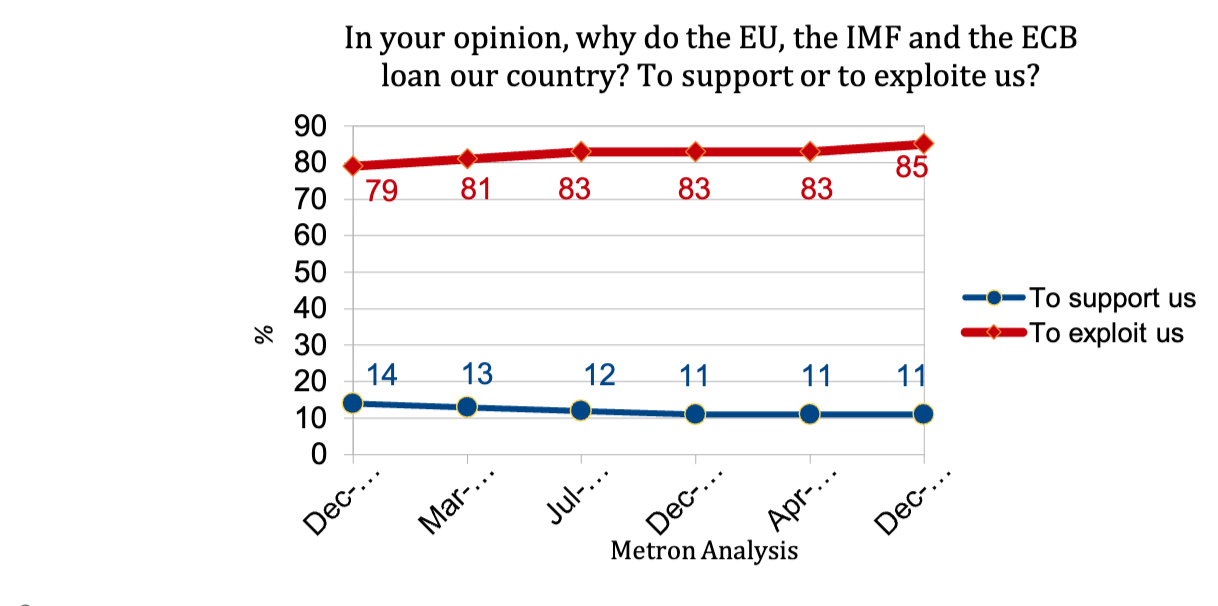
In April of 2011, Eurobarometer’s respective indicator recorded for the first time since 1983 a majority of 50% being of the opinion that the country has not benefited from its participation in the Union. Between March 2011 and December 2012, an average 83% of the respondents stated that the E.U., the E.C.B. and the I.M.F. provided loans to the country not in order to help but to take advantage of it.
At the same time, it is noteworthy that the significant drop in support for Europeanism was not a linear process. Mild eurosceptic tendencies inscribed in the social movements’ discourse were often related to the social ramifications of MoUs and the Troika which was fiercely criticized for its policy and mode of conduct. In other words, Troika was primarily targeted for its track record not its composition or relation to the EU. This is not to say that eurosceptic elements were absent but rather to suggest that the movements’ overall discourse was neither explicitly eurosceptic or anti-EU. The process was full of contradictions which were also reflected in the forces forming the coalition government in 2015 and their stance towards the European Union. Both SYRIZA and the Independent Greeks were not anti-EU forces. SYRIZA expressed a critical Europeanist viewpoint, with the vision of Greece standing equal amid equals in Europe. SYRIZA promised that it will end austerity and through negotiations with the institutions that would lead to an “honourable compromise”. This rhetoric was also based on the belief that the previous governments did not really negotiate the terms of the bailouts. SYRIZA’s majority faction exhibited a clear pro-EU orientation rooted in the traditions of the Greek eurocommunist left. In contrast, the Left Platform (a block within SYRIZA with almost 30% of SYRIZA MPs after the January 2015 elections) supported an exit from the Eurozone. Other important figures, like Varoufakis, the Minister of Finance at the time, was in favour of a Plan B in case it was needed.
C. The zenith of Euroscepticism in the July 2015 referendum
Unable to extract concessions from key EU players and under heavy pressure, SYRIZA government declared a referendum over the Troika’s final bail-out proposal in late June 2015. The government called for a No vote but was adamant that the referendum was about the MoU policies and not the country’s membership of the EMU. In its discourse, the rejection of the Troika’s proposal was framed as the beginning of a new course for Europe, a victory of democracy over the wishes of neoliberal technocrats etc. In the period prior to the referendum we observe a dramatic re-emergence of the strategic dilemma –memorandum or Grexit. EU officials and the domestic pro-memorandum opposition (the campaign “We remain in Europe”) insisted that the bailout agreement was a pre-condition for the country to remain in the eurozone. A NO vote would lead Greece to bankruptcy and an immediate exit from the EMU. Polarization accelerated sharply and it was not only discursive. EU’s pressure had very tangible manifestations. By far the most important was ECB’s decision not to increase capital injections in the Greek banking system effectively forcing its closure.
The result was a resounding rejection of the bail-out deal with the NO garnering 61,3% of the votes against a 38,69% in favour of the YES. The least to say is that those who voted NO understood that their vote might imply a rupture with the EU. It seems that the initial resentment towards the Troika during the early 2010s turned in the course of 2015 into a solid Eurosceptic current questioning the European project as such. The NO vote has been aptly described as a ‘tremendous show of determination from the part of the subaltern classes’. A week after the referendum, Tsipras returned to Athens from Brussels having agreed to a third Greek bailout on terms worse than the ones rejected by the 61.3% of the voters in the referendum. “Kolotoumba”, meaning somersault) became a fashionable term in 2015 in response to the tactics of Alexis Tsipras. Syriza’s left wing has split from the party a few weeks after the third memorandum was signed. Tsipras had to call an early general election in September 2015. SYRIZA was re-elected but far from the promised “anti-austerity government,” it has become the “third memorandum” government.
D. Thoughts on the pro-EU and the anti-EU stance in the aftermath of the referendum
Survey data for 2015 provide a wider view of the pro-EU and the anti-EU preferences among the Greek population:
- According to the Eurobarometer, in Autumn 2015, Greeks exhibited the highest levels of distrust in the EU at 81%, that is, 26 percentage points higher than the EU average.
- According to a quantitative and qualitative survey by the diaNEOsis think tank during 2015, the political-ideological composition of hardcore of Eurosceptics goes as follows: leftists (37%), the far-right (10%) and far-left (7%), center leftists (14%) and centrists (12%). The ideological makeup of the anti-EU camp is particularly interesting and shows that it is the Left that sets the tone for the anti-EU camp in Greece.
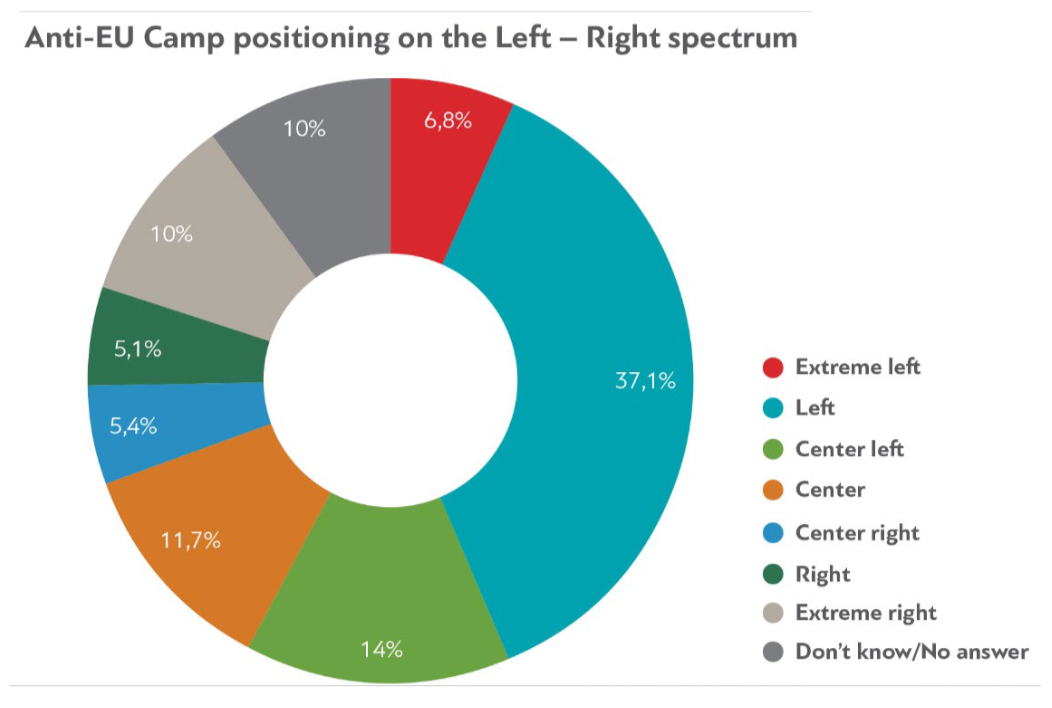
- – According to diaNEOsis’s analysis, the significant drop in support for Europeanism in numerical terms has shifted the balance of power between the pro-European and the Eurosceptic camp, with the latter growing in strength. However, the pro-European camp continues to dominate and remains the majority view, in a way that is not open to any doubt.
- Euro-realism is the heart of Greek pro-Europeanism. Instead of embracing a positive image of EU project as the “European dream”, the majority tends to believe that Greece should remain in the EU and the Eurozone since “there is no alternative”. This is important and aligns with one of the most crucial findings of the interviews and focus groups we conducted: that is the growing levels of political cynicism in the aftermath of the referendum.
E. Key questions
In comparative terms, there are two main questions that we would like to address:
- In the other crisis-ridden countries the EU related issues were not widely contested and did not shape the political competition. Why is that? – In Italy the rise of the radical right is accompanied by a slow but prolonged decline in pro-EU attitudes, but this doesn’t seem to be directly reflected neither in political competition nor policy. Why is that?
- What was the impact of the Greek bailout referendum and the victory of the NO vote on the Letiist Parties’ stance towards Europe? – What was the impact of SYRIZA’s U-turn after the referendum?
– What are the main obstacles that hindered the emergence of left-wing Euroscepticism in the other countries?
Indicative bibliography
Bird, M. (2015), “Italy’s PM says Greece’s referendum is a choice between the euro and Grexit”, Business Insider, available at: https://www.businessinsider.com/italian-primeminister-matteo-renzi-says-greeces-referendum-is-a-choice-between-the-euro-andgrexit-2015-6 Boukala, S., & Dimitrakopoulou, D. (2017), “The politics of fear vs. the politics of hope: analysing the 2015 Greek election and referendum campaigns”, Critical Discourse Studies, Vol.14, No.1, p:39–55. https://doi.org/10.1080/17405904.2016.1182933 Constantinou, M. (2018), “Resisting Europe, setting Greece free: Facebook political discussions over the Greek referendum of the 5th July 2015”, Lodz Papers in Pragmatics, Vol.14, No.2, p: 273–307. https://doi.org/10.1515/lpp-2018-0014 Crespy, A., & Ladi, S. (2019), “In the name of ‘the people’? Popular Sovereignty and the 2015 Greek referendum”, Journal of European Integration, Vol.41, No.7, p: 871–885. https://doi.org/10.1080/07036337.2019.1665661 Dijsselbloem, J. (2018), “The euro crisis: The inside story”, Prometheus, New York Euractiv (2011), ‘Greek Referendum Gamble Panics Leaders, Markets’, Euractiv.com., available at: http://www.euractiv.com/euro-finance/greek-referendum-gamble-panics-lnews-508682 Juncker, J-C. (2015), “Transcript of President Jean-Claude Juncker’s press conferene on Greece”, European Commission, available at: https://ec.europa.eu/commission/presscorner/detail/en/speech_15_5274 Kutter, A. (2014), “A catalytic moment: The Greek crisis in the German financial press”, Discourse & Society, Vol.25, No.4, p.446-466, DOI: 10.1177/0957926514536958 Papadimitriou, D. & Zartaloudis, S. (2015), “European discourses on managing the Greek crisis: Denial, distancing and the politics of blame”, in Karyotis,G. & Gerodimos,R., “The politics of extreme austerity: Greece in the Eurozone crisis”, Palgrave-MacMillan, London. Varoufakis, Y. (2017), “Adults in the room: My battle with Europe’s deep establishment”, Vintage Publishing, New York/London.
Discussion
Catarina Principe (Portugal)
EU is a generally positive thing in Portugal
The voter turnout is declining constantly in the Portuguese elections. But you can see a clear shift from 1987 to 1991, which is a very interesting shift, in my view, because that’s exactly the moment when Portugal joined the then European Economic Community. The perception of the European integration was very positive in Portugal throughout the 1980s and the 1990s. In the 1990s it started to be a bit harder because European integration was the justification for the rampant privatization program of the revolutionary nationalization process. But in general, belonging to the European Union is seen as a very positive thing. At the same time, I think that there’s an understanding that there are some decisions that have been taken away from the national sphere that affect voting patterns.
Greece as a disciplinary case vs Portugal as a success story – Explaining why EU is perceived positively in the crisis moment
The narrative of why Portugal is not Greece is something that we heard many times in Portugal during the four years of the memorandum. It was constantly repeated. And it is partially true that when the crisis imploded, Greece had a much bigger amount of former public debt than Portugal did. Portugal was framed to be a good student from the beginning. In contrast, Greece was framed as the exception. Because of the memoranda, the Greek situation exploded into a moment of high levels of contestation. It didn’t happen in the same way and to the same degree in Portugal. And because of that, the memorandum agreement for Portugal was much less harsh than even the first Greek memorandum. And I think this is very important. So, there were benefits that were given for political reasons. Portugal was identified as the justification that austerity works. If you behave properly, European institutions will give you some benefits. One of the biggest examples is quantitative easing where the European Central Bank bought directly public debt bonds. It’s forbidden under European law and it was not given to Greece, although PASOK asked for it. However, It was provided to Portugal in order to meet the criteria for the evaluation of the first memorandum in order to decide whether Portugal had to ask for a second or not. Merkel and Schäuble had a very important role to play in this. You had to have a success case. Greece was the disciplinary case and Portugal was the success story. And I think that totally shifts the way in which the relation with the EU is perceived.
The Portuguese Left and its stance towards the EU – SYRIZA’S capitulation and the impact of Brexit
In the 2015 elections, the Left Bloc had an openly critical stance towards the EU, because it was the moment for it. The Left had very good results on the most openly critical to the EU platform since the existence of the Left Bloc. The Communist Party has been Eurocritical since the beginning as a principled question. So, that was steady for them. But after SYRIZA’s U-turn, Left Bloc would change its public position on the EU, which is a very interesting thing. And the Communist Party was punished at the polls. You can see it in the European elections, how much the CP lost votes because they were the only party that maintained their principled stance of being anti-EU and supported the exit from the Eurozone. After that, Brexit came and people thought, okay Greece couldn’t do it. If Britain, that is this powerful country, can’t do it, then we are completely locked into this situation. I think this was the feeling.
Contradictory citizens’ attitudes towards the EU – “negative but impossible to get out of”
In 2019, I went to the Historical Materialism conference in Athens and I was in a panel with Josep and Panagiotis Sotiris. There, I brought a poll that came out for the European elections of 2019 in Portugal that I think reveals the contradictory consciousness about belonging to the EU. 89% of the people said we should not leave the EU and 79% of the people said we should not leave the Euro – people tend to think these are two different things but in reality you cannot leave the Eurozone without leaving the EU. But then when you asked how the European Union is perceived, the people had mainly preoccupations about unemployment, loss of sovereignty and imposition of fiscal rules and austerity. In this sense, the European Union was perceived as something that is not overall positive but impossible to get out of. And I think this is precisely the conundrum of the Left and it’s very hard to articulate strategy on this question, specifically because of this contradictory understanding of the EU. And SYRIZA’s experience was definitely what crystallized this contradictory feeling. And so it made the task for the Left concerning the EU a much harder one.
Lorenzo Zamponi (Italy)
On the populist use of referendums “asking people to vote on something, which is not in your power to determine” – the Greek and the Catalan case
I agree on many of the things that Catarina said. But I want to add a couple of things on the Greek referendum because I think we have to elaborate on the populist use of referendums. And I think there is a clear analogy between the Greek referendum and the Catalan referendum. In both cases you have a populist use of referendum, in which you ask people to vote on something which is not in your power to determine. And that backfired. It’s quite easy to understand why it backfired. You asked the people: do we want a better memorandum? Sure. Do we want independence for Catalonia? Sure. But you’re not in power to provide a better memorandum or independence to Catalonia. You have to negotiate it with someone else. And this is a strategy on which I think some reflections should be done. And you mentioned also the fact that in the NO vote to the referendum, there was a strong implication of being determined to follow a Grexit. I have to say that if I was the Prime Minister, I would need more than an implication to get out of the EU. I would want an explicit mandate to do so.
Impact of SYRIZA’s capitulation + Brexit on the Italian Left – the crisis of critical Europeanism and the legacy of Eurocommunism
The Italian left not only followed very closely what was happening in Greece. You have to remember that in the European elections of 2014, the list we ran for the European elections was called “Another Europe with Tsipras”. It embodied precisely the “democracy versus markets” narrative, which was the narrative of the European Left at the time. SYRIZA was the link of the chain which was closest to the conflict that was going on, but that was the common line of the European Left. And you can obviously imagine the shock of what happened after the referendum. And this definitely brought a crisis of critical Europeanism. Critical Europeanism has been the line of the Party of the European Left and of most of the European Left for the previous decades. It was not something particularly new, there is a long standing tradition of critical Europeanism. Eurocommunism was invented in Italy and it’s strongly attached to the identity of most of the Italian left. It’s very difficult to think about yourself as anti-EU in Italy. Critical Europeanism was brought obviously to a crisis, because the claim “another Europe is possible” met the fact that another Europe was actually not that possible. And the idea of changing Europe definitely proved to be something hard to do. You mentioned before the narrative of “there is no alternative” which ended up being dominant. The problem is that this narrative was extremely conservative but also very close to reality. What Catarina said about the effect of Brexit was very visible in Italy as well. Because for some time after July 2015, there were definitely visible tendencies within the Italian Left saying that we should actually consider a Plan B and all this stuff. They were very small in terms of parliamentary representation, but these tendencies existed in every party and people were discussing about that and so on and so forth. After Brexit, this became a lot rarer. Because once again, as Catarina showed with the poll, people don’t like the EU and at the same time they don’t think it’s even possible to get out of it.
Anti-EU tendencies on the Right and their limits
There are also different reasons for which not everyone agrees on the fact that it is desirable to get out of the EU. This works both on the Left and on the Right. In Italy, the party that embodied confrontation with the EU for a long time, which was the League, never actually considered going out of the EU because its structural base is small businesses in the Northeast who are, from an industrial productive point of view, part of the German-centered chain of value. Italy is still the second largest manufacturer in Europe and still an industrial country, a client of the German industrial system. This was very visible on the Right, but also in the trade unions.
League – M5S coalition government in 2018 – the failure of a more confrontational strategy
And, then, in 2018, we had a coalition government between the League and the M5S, mostly based on a sovereignist confrontation with the EU. And nothing came out of it. The government collapsed because after the European elections of 2019, the M5S ended up moderating its stance towards the European Union and voting for Ursula von der Leyen as President of the European Commission. The League wanted to maintain their more confrontational stance and decided to exit the government and try to govern alone, which actually did not happen. So, there has been the failure of critical Europeanism, but there’s also been the failure of a more confrontational strategy towards the EU. And that “there is no alternative” stuff, it’s very difficult to say that it is objectively true, but it’s something that has strong empirical support. And this is something that a big part of the electorate, not only on the left, strongly sees.
Paolo Gerbaudo (Italy)
On the different trajectories of EU integration, Italy’s peculiarities and the identification between EU integration and democracy
Different Southern European countries have different trajectories of EU integration that speak to EU legitimation in each country. Italy’s trajectory is, of course, different, since it’s one of the core six countries of the Treaty of Rome. And my sense is that in Spain there is very strong identification between EU integration and democracy, which may partly apply to Greece as well, since it is also a country exiting from dictatorship quite recently. I was quite impressed during the campaign of Sanchez by the extent to which he constantly pivoted on the EU as a source of legitimation, basically saying that we are the force that is the safest for the EU while Vox is considered dangerous by the EU, even by quoting the EU commission. Even though I think he was not really expedient politically, because I don’t feel that the Spanish electorate cared so much about these facts, I actually think it is more counterproductive propaganda wise, to say that you should vote for me not because I stand for the Spanish people but because Brussels officials consider me the most reliable force. This is very interesting ideologically. In Italy, there is strong Europeanism on the Left, which speaks to many issues. It speaks, of course, to fascism and its legacies, it speaks to longstanding cultural peculiarities of Italians that go back to what Gramsci called the Italian cosmopolitanism, late national state formation, but also being the seat of the Roman Catholic Church and what that entails in terms of cultural universalism, the historical dispersion of Italian intellectuals etc. So, there are all these factors that are very important in understanding why there are all these different trajectories.
Complex of inferiority
Then there’s also a complex of inferiority, a kind of psychological element that the Southern European countries share. That’s not hiding. In a way they need an external agent to legitimize them and Europe is very much this kind of big brother, the fatherly figure, a body of certification for being part of the West, adequate, good enough and civilized.
2020 – Italy’s warning to Europe
In the Italian context, a very important and symbolic moment is the 12th March 2020. We are at the very height of political panic about Covid. There is the red zone in northern Italy. COVID has not yet struck other countries. Italy is basically isolated vis a vis the reactions of financial markets and vulture investors attacking Italian bonds. And the famous spread between German Bund and Italian BTP skyrockets. Lagarde and the ECB basically say “we don’t need to do anything”. And it’s interesting because at that point, even the President of the Republic, Mattarella, who is one of the most pro- European figure in the most pro-European party in the Italian system, the Partito Democratico, basically went out and made this rather untypical, uncharacteristic declaration which was described by the press as a warning to Europe, where it declared that we as Italians expect rightly from our partners solidarity initiatives in the name of common interest. This was a quite uncharacteristic action, and sometimes it’s precisely these anomalies that tells you more what normality is. And normality has been basically the complete adherence to European integration policies.
The mode of suspension during COVID “opening space for maneuver” and its impact on anti-EU attitudes
But I think the decisive thing that happens with COVID – and that is still open – is that the austerity consensus or the austerity policies of the 2010s suddenly gave their way to another approach which was more geared towards investment, Next Generation EU grants and loans. And this was a different intake from the so-called Frugal Four. There is this mode of suspension. So what has happened since COVID is basically this opening space for maneuver. It’s not that the rules have changed, the rules have remained the same in terms of Maastricht treaty rules etc., but they’ve been suspended, article 104 and following the EU treaty. There’s this lapse of regulation, which they’re trying to overcome now. It looks like negotiations on spending rules are advancing. What has happened to the anti-EU attitudes? These have been suspended a well because there was a sense that the EU was reconsidering its stances, but they may well rise once again if we move back to a kind of a new austerity wave, like Germany, at least Christian Lindner advocates.
On the “remain and counter-reform” right-wing strategy
Finally, in terms of sovereignty, the shift from a kind of exit strategy to what we could ironically term “remain and counter-reform” strategy has been a very interesting development in the strategy of the Right. The “remain and reform” was the Labour Party option, which Corbin himself supported in the campaign in the 2016 UK referendum. What the Right is doing now is basically accepting they cannot really break from the EU, but feeling strong enough to come together to win the elections next May 2024, ally with the popular party and redefine what the EU is about to gear it more towards their own interests. Ultimately, it seems there’s no big contradiction between their nationalist agenda and a kind of pan-European agenda. Their aim is to turn the European Union into basically a Europe of nations, as they call it, an agent that: A. disempowers all democratic demands of redistribution and democratic control over the economy and B. gears it towards a war of civilization, a Euro-Atlantic front.
Worries about the direction of the EU – legitimacy of EU’s involvement in the war in Ukraine + enlargement/internal consolidation contradictions
To conclude, I’m really worried about the direction of the EU because I think that the degree to which the EU has gone into the war in Ukraine is clearly not keeping with the legitimacy it has to do this. There is a clear hiatus between the level of commitment they give to this cause and the lacking legitimation for doing this. Another very big worry in the long term is precisely the EU enlargement, this kind of ambition which I think is completely misguided because the problem now is the internal inconsistency, institutional and otherwise, of the EU as it stands. Probably the EU is already too big as it is, the expansion has already been accelerated. And we know that there is a trade off between enlargement and internal consolidation. So perhaps if Schäuble had said one good thing was the idea of a kind of multiple speed Europe or whatever. And also it’s dangerous in terms of war. If you are a political entity that has no borders, that is proper for empires. What would be the limit point of the EU, Georgia, Armenia, then what? This is likely to be a sore point in the future political and electoral mobilization.
Jorge Sola (Spain)
In Spain, there is a motto that says, “if Spain is the problem, Europe is the solution”. It was coined by a philosopher and this motto has a lot to say. The critique of Europe, or the EU is out of the agenda.
Paolo Gerbaudo: Very similar to Italy.
Josep Maria Antentas (Spain)
EU is a generally positive thing in Spain – Explanations
There is a long tradition of Europeanism in general, in the public opinion and in the Left. It’s not an active, but rather a passive one. In 2006, there was a referendum for the so-called European Constitution and Spain was the first country that was chosen to have a referendum. Then the process was blocked because of the NO vote in France, but Spain was chosen as the first one to have a referendum because it was clear that people would vote yes. Although it’s true that it was a referendum with very low participation. Europe has been historically perceived as the horizon of normalization and modernization of the country after the Second World War backwardness, after the dictatorship, or even longer since the decline of the empire. The idea that Spain had lost the train of modernity has created this feeling that Europe is the kind of horizon where Spain should try to converge. This is quite rooted both culturally and politically in Spain. And when it comes to the economic crisis, Europe has not been perceived as a direct actor. There was not a direct intervention with memorandums and so on. It’s true that the Rajoy government has been controlled by Brussels, all the budgets were supervised but it was something that was done behind the scenes. There was not a clear sense of men in black arriving in the country like they did in Greece. At the end of the day, the political crisis in Spain was framed as a national or domestic crisis. The 15M movement was against politicians and so on, but the European dimension never took off as a central element of criticism. This is certainly a weakness.
Impact of SYRIZA’s capitulation on the Spanish Left – “skipped the debate”
My feeling is that the Left in Spain preferred not to discuss that thing. When Tsipras won, Iglesias was leading the polls and it was also a good example of what Podemos could do. I think one of the reasons why the European Union was so hard with Greece, and there was never a chance to make any deal with the European Union, is because it was not just a Greek problem. If Syriza was able to make a good deal with the European Union, then everybody could do that and the next one would have been Iglesias and Spain. Then when Syriza capitulated, everybody stopped to talk about Greece. Let’s forget about Greece, we’re going to win the elections in Spain. That was Iglesias’ way of dealing with that. No worries, Spain is a big country, when I am the President, I will be able to have more margin of maneuver than Greece. So I think that Greece was a skipped debate on the Left because of two negative things. I mean discussing seriously about Greece implied to seriously discuss what the Left should do in Spain in case of being in the government and to question many of the things that the Left was already doing. There was no real discussion because it was the moment of the delusion of a rapid victory of Podemos and so on. So just the radical Left had some debates, but there was no real debate in the Left as such. I think that Greece simply stopped being a model or a point of reference.
Catarina Principe (Portugal)
Troika towards Greece: Hindering the possibility of a domino effect
I wanted to build on what Josep said. I think the question of domino effect, the possibility of domino effect, was a very important question for the Troika. So if an anti-austerity left-wing project at that point in time could actually negotiate some sort of anti-austerity program, that would have probably created a domino effect, because you were seeing the polls in Spain with the rise of Podemos, but also in Portugal – not as well as in Spain, but still growing. And I think trying to stop this domino effect explains both the harsh disciplinary form of relating with Greece and the support of Portugal. It’s a political decision to hinder any possibility of a domino effect.
World systems theory: Greece, Spain, Portugal peripheries / Italy semi-periphery
Hearing what Paolo was saying, I was thinking that if we apply a sort of a world systems theory, European style, I would say that in the question of European belonging Italy is a semi-periphery and Portugal, Greece and Spain are peripheries. Because, as Paulo said, Italy was one of the initial six countries and this is not a small thing. These six countries were able to inscribe national interests into the acquis communautaire, into the laws that all the other countries that join afterwards have to take over. It’s undebatable. You just have to accept the whole body of legislation. Italy has an interesting story. I’m not an expert on Italy, but there are a lot of interesting analyses in the political economy literature, like the Baccaro school – I don’t agree with them on everything, but they do have some interesting points on Italy; namely the idea that it is precisely the specific type of Italian industrialization, that with the existence of the common market, then started to compete with German products. And then later the introduction of the Euro with the hyper valorization of the lira in relation to the devalorization of the Deutsche Mark that put Italy in a really semi peripheral, almost peripheral position. So it’s a later dynamic, different from the dynamic in the beginning. The EU also has two phases. There was the first phase of European integration until the 1970s and a different phase which corresponds to its neoliberal phase from the 1970s on. And Portugal, Spain and Greece joined in the 1980s (Portugal and Spain joined in 1986 after nine years of negotiations). When they joined, it was a different moment which meant different things for national countries. The level and the degree of externally imposed economic specialization is much deeper than what happened in Italy.
Identification between EU integration and democracy
I agree with Paolo. For Portugal, joining the EU comes as a feeling of stabilization or of political normalization after the revolution. It’s very linked with the idea of democracy in popular understanding. And I think that’s exactly the same for Spain. And they happen concurrently.
Horizontal ties VS vertical ties: A sovereign decision to lose sovereignty
Last point I want to make is related to some political theory and international relations scholars I am using in my work, like Christopher Bickerton. He talks about the dimension of member statehood. He refers to the process of European integration from the 1970s on and notes that national governments substitute horizontal to vertical ties, meaning with those horizontal ties that link states and their populations in forms of gaining legitimization. The EU now is actually a form of acquiring political legitimacy that comes from above and not from the state-society nexus, which were the former horizontal ties. And what is interesting is that it is the governments that bind themselves to these international rules that then they suffer from. So it’s a sovereign decision to do this, although it implies a loss of national sovereignty. And this is why it’s so complicated to navigate this question because there’s these two dynamics happening all at the same time.
Lorenzo Zamponi
The ideology of “external constraint”
What Catarina commented on the industrial transformation is 100% correct. And this is also the political economy structural basis of a very clear ideological stance, which is dominant in Italian politics. This is the ideology of the so-called “external constraint”, exactly the structural base that Catarina summarized. This idea that the monetary union can act as an external constraint forcing the Italian economy to transform into a certain direction. The idea that the development of Italian democracy as it emerged from the economic miracle of the late 1950s and early 1960s has to change. A person who was fundamental in the last 30 years of Italian politics, Romano Prodi, who was twice Prime Minister for the center-left and President of the European Commission, etc. is one of the main proponents of this idea.
“The Bocconi boys go to Brussels”: the main academic ideologues of austerity came from Italy
It’s difficult to portray European austerity as a colonial invasion in Italy, based on the fact that the main academic ideologues of austerity came from Italy. There is a very good article published in 2015 in the journal of European Public Policy with the title “The Bocconi boys go to Brussels” which shows that the proponents of expansionary austerity and those who popularized austerity and a strict monetary approach in the EU circles were people like Alberto Alesina and Francesco Giavazzi, the most important economists in the country. Alesina died in 2020 but Giavazzi was still the main economic advisor to Mario Draghi last year. So this is also something that has to be taken into account. There is an intellectual link which is really internal to Brussels circles, but it’s domestic, it’s Italian.
Drop in trust towards both the EU and the national institutions
Then, Paolo also quickly mentioned it but I think it’s very important: In order to favor exiting the EU, it’s not enough to distrust the EU. You need to trust your national institutions more than you trust the EU. And if you see what’s happening in Italy in the last decade, there is a drop in the trust towards the European institutions but the mistrust towards the national institutions is still there. The idea of taking back control, which was very important, for example, in the Brexit discourse, never really entered the mainstream public discourse in Italy because it’s like “Who’s taking back control? Political institutions we don’t trust”. This is really rooted in the crisis of the early 1990s, the idea of endemic corruption and so on and so forth. The normalization role of the EU is really the political moral counterpart of the economic external constraint.
The new national conservative right: The Poland model and its weaknesses
Last point about this new national conservative Euro-Atlantic Right, which is very visible and is the political project of Meloni. I think what just happened in Poland is an interesting development from this point of view because Poland was the real model. Obviously for propaganda reasons, when the Left attacks Meloni always mentions Orban because Orban is the big scary monster, but the real similarity was with Poland, because Poland was the country which was nationally reactionary but also strongly siding with the Euro-Atlantic consensus. And the fact that that model showed some weaknesses, it’s going to be interesting towards the next European elections.
Josep Maria Antentas
Other cleavages and the EU parameter: The pro-EU pro-independence Catalan movement
I just wanted to add something on Spain, because apart from the 15M and Podemos, you had all the other cleavages related to the Catalan independence movement. And it’s also interesting to explain how they relate to the European Union, because one of the facts that has been very clear is that the Catalan movement for independence has been very much pro European Union. Well, there is an important minority around an anti-capitalist wing called CUP which is against the European Union, but the majority trends of the movement are pro-European Union. And the debate on independence was never posed in terms of what it means, for example, to be independent from Spain and don’t have a national currency or stop being part of the European Union. It’s just independence from Spain. We want a new state but, of course, this state is in the European Union, in NATO, with common currency and so on. Besides the fact that there is a kind of tactical element, that if you want to create a new state, you need to be recognized by the other European states – this is obvious – the main components of the Catalan independence movement see this project clearly in the framework of Europe. You have two big political trends in the movement. One is a kind of center-right neoliberal or liberal wing, and the other more social-democratic one. And both imagine an independent Catalonia in Europe. For the right-wing trend, Catalonia would become a kind of small, competitive, high tech country in Europe, without the burden of Spain. And for the more social-democratic wing, Catalonia will be a small well managed rich country that will be able to deliver a reasonable welfare state, like a Scandinavian country. That also shows the extent to which the EU is not perceived or framed as part of the problem in Spain. In the beginning of the Catalan movement, the first reaction of Spain was that if you leave Spain, you will be expelled from the European Union, which will be chaotic and devastating for you.
Concluding remarks
Costas Gousis
During the last decade, we have all participated in numerous discussions about the social movements and the political transformations in conferences, articles in journals, collective volumes etc. What I think is quite different in the discussion that we’re having in this workshop is that we’re in the moment after the defeat has been realized and we can reflect on the previous decade in a quite different perspective. Things went really bad. As we said, the magic is gone. There is a feeling of political exhaustion. There is also maybe a feeling of theoretical exhaustion and we’re trying to return to the previous decade and rethink our political analysis, rethink our political, viewpoint, point out elements that might have been overestimated due to what Paolo said about the heated moment, the moment of hope in the past or elements that might have been underestimated. I think that the elephant in the room is what Lorenzo said about the TINA doctrine that it is so conservative and at the same time it seems to be very close to reality. I think that this is what we should discuss more and more. And some further key points and questions that came up to our discussion and point to serious challenges for a political reflection: Is there anything that could have been done differently from the left parties during the last decade? Are there any milestones that could have changed the course of history? What are the most important key takeaways for the future and the next decade? How can we discuss contentious politics if we all agree that there is this kind of desire for normality? And how can this desire for normality be fulfilled when everything seems to be tending to a new period of destabilization globally, taking under consideration geopolitical developments and also the difficulties of the governments to deliver something to the people in order for the people to be happy about it. I think that the transcript of our four sessions will reveal very interesting comparisons, both similarities and different dynamics, as well as challenges we can discuss about, publish something together or prepare something together, a conference or a collective volume or anything. It depends on how much time we have and how much energy we want to give to this. But, uh, it’s, it’s very interesting that we started like that.
Angelos Kontogiannis
What motivated us to go with the workshop and in a setting like this was that in reality, the 2023 elections in Greece permanently closed the cycle that opened in 2011 with the crisis. I know this is not the same. It’s quite evident from the conversation that for Spain, Portugal etc. the dynamics is very different. But at the same time what we are really interested in is what Paolo said yesterday. Our aim is to collectively revise our perspective of what happened during the crisis focusing on the dynamics that stemmed, in reality, out of it with an eye on what is happening now. There are certain key areas: First of all, the character and dynamic of the cycles of contention in the first period of the crisis and the actual depth of the transformations that they produced in short term and in the long run (transformations when it comes to political parties from the left-wing and the right-wing spectrum, the union movement etc. What we are working on now is the post-2015 dynamics. The way we approach it methodologically is primarily through qualitative research – around 75 semi structured interviews and 10 focus groups with seven participants each. So this is a total of 145 people, not a representative sample, but quite indicative, and particularly when it comes to the focus groups, we have tried to keep a socio demographic balance and political balance quite strictly. To follow through the development of certain dynamics, part of the 75 individual interviews were conducted with people that were first interviewed immediately after the 2015 referendum. So, we return to the same people seven years later and try to see how they have moved ideologically from one point to the second. What would be really interesting for us, if it is possible, is to combine our data with your data in a comparative perspective upon some major axis.
Dora Fonseca
I can begin by saying that this season, this was all very interesting and that I had, just because, um, I don’t know if you know, you guys know all of you, but My field of expertise is industrial relations and I had some difficulty in following, following all the discussion. Of course, these dynamics are very important to understand and the industrial relations field can contribute to it focusing on these dynamics within the trade unions and union confederations regarding social dialogue, and so forth. Maybe that would be a topic of interest to focus more on the labor fields.
Paolo Gerbaudo
I think this was really interesting. I didn’t know what to expect from this, but I think it was very interesting. It’s a very like minded group of people. I didn’t have a personal opportunity to do strategic discussions. I remember that the last time there was something like this, it was in 2015 in a conference in Athens just after the referendum. So to me, it was like going back to that moment and making an update. I just wonder what you want to do with this, whether you’re thinking of doing something further with this.
Catarina Principe
I also didn’t know exactly how the discussion was going to be framed. And I learned a lot and it was very interesting for me. And I also like going back to this moment in this conversations and think again about it. It was very helpful to restructure some of my thoughts. I want to read the minutes and I think there are some things that can be further done. Some sort of international conference, precisely on this subject in 2025 celebrating the 10 years of the big moment of possibilities and then the big U-turn. Um, so maybe this is also a core of people that could think about something like this.